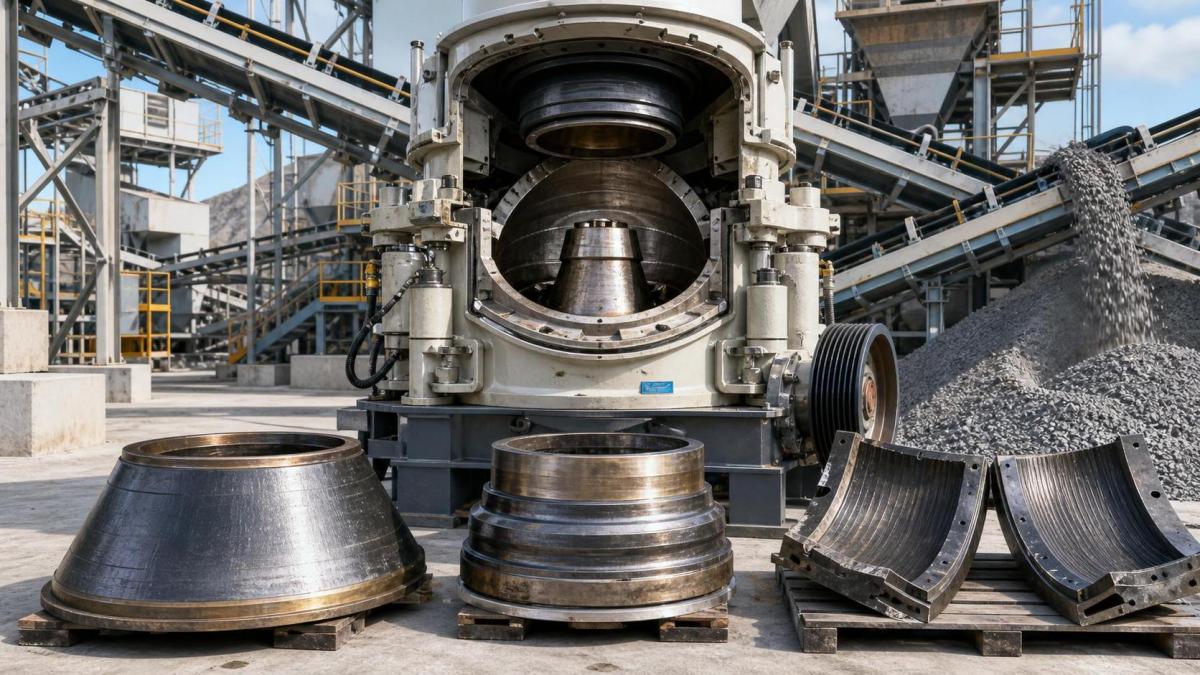
When to Replace Hydraulic Cone Crushers Wear Parts
auth.cTime
Jul 05, 2026Click Count
When does wear become a replacement issue, not just a maintenance note?

Hydraulic cone crushers wear parts rarely fail without warning. The real problem is that wear often becomes normal background noise until output quality starts drifting.
In aggregate plants, quarries, and mining circuits, that delay is expensive. A chamber that still runs can already be hurting gradation, recirculating load, and power efficiency.
That is why replacement timing matters. The goal is not to use liners until they are destroyed. The goal is to protect uptime, product shape, and crushing stability.
Across heavy infrastructure equipment, HIES often frames maintenance questions around lifecycle ROI rather than simple part consumption. Hydraulic cone crushers wear parts are a clear example.
A worn mantle, bowl liner, torch ring, backing area, or seat surface changes how force moves through the chamber. Once that happens, performance loss usually arrives before visible failure.
So the practical question is not only, “Are the parts worn?” It is, “Has wear started to reduce crushing efficiency enough to justify a planned change?”
What are the first field signs that hydraulic cone crushers wear parts should be replaced?
The earliest signs are usually operational, not dramatic. Plants often notice unstable product size before anyone sees extreme liner thinning.
A few symptoms tend to appear together:
- More elongated material or poorer particle shape.
- Higher circulating load in closed-circuit crushing.
- Reduced throughput at the same feed condition.
- Increased amp draw fluctuations or hydraulic pressure instability.
- CSS adjustments that no longer recover the target gradation.
- More tramp-related stress because the chamber is no longer wearing evenly.
In actual operation, uneven wear matters more than average wear depth. One side of the chamber can become aggressive while the other side goes flat.
That uneven profile changes material flow. Rock starts sliding or packing differently, which affects both reduction ratio and liner life.
Another common signal is a narrower operating window. The crusher becomes more sensitive to feed segregation, moisture, or fines content than it was earlier.
When that happens, hydraulic cone crushers wear parts are usually near the point where replacement gives more value than repeated adjustment.
Can you judge wear by hours alone, or do load conditions change the answer?
Hours help, but hours alone are weak guidance. Two crushers can run the same time and show very different wear patterns.
The bigger drivers are feed hardness, abrasiveness, feed size distribution, choke feeding discipline, and how stable the circuit stays under load.
A cone running abrasive granite, iron ore, or high-silica stone will consume hydraulic cone crushers wear parts much faster than one processing softer rock.
Likewise, poor feed presentation shortens life. A chamber that is starved, segregated, or repeatedly hit with oversize tends to wear irregularly.
A more reliable approach is to combine three records:
- Operating hours since installation.
- Tons processed during that wear cycle.
- Performance drift, especially gradation and power behavior.
That combination is far more useful for planning shutdowns. It also supports better comparison across sites, materials, and chamber profiles.
For plants tracked through broader equipment intelligence systems, this kind of wear history becomes part of cost-per-ton analysis, not just a maintenance log.
A quick judging table helps during inspections
The table below works well as a field reference when deciding whether hydraulic cone crushers wear parts still have productive life left.
Which wear parts usually drive the replacement decision first?
Most decisions begin with the mantle and bowl liner because they define the crushing chamber. When their geometry moves away from design, everything downstream starts shifting.
Still, it is risky to focus only on those two parts. Hydraulic cone crushers wear parts should be reviewed as a system.
The usual check points include:
- Mantle thickness, profile loss, and uneven wear bands.
- Bowl liner retention condition and seating integrity.
- Main shaft protection areas exposed by liner loss.
- Burn ring, clamping surfaces, and support ring damage.
- Backing material condition where relevant.
More serious problems start when a wear part has consumed enough material to expose structural surfaces. At that point, the repair scope can expand quickly.
That is why experienced teams schedule liner changeouts before secondary damage reaches the head, bowl, or adjustment mechanism. Those repairs cost much more than the wear parts themselves.
What mistakes cause parts to be replaced too late or too early?
Replacing too late is more common, especially when production pressure is high. A machine that still runs is often assumed to be acceptable.
The hidden cost is that worn hydraulic cone crushers wear parts can reduce yield long before they stop the machine. The plant pays through rework, energy, and unstable screening.
Replacing too early also happens. This usually comes from using fixed calendar intervals without checking tonnage, chamber profile, and actual material conditions.
The most frequent mistakes are easy to recognize:
- Using visual thickness alone without measuring performance loss.
- Ignoring feed segregation that mimics wear-related problems.
- Missing uneven wear because inspections are too brief.
- Changing liners without checking mating surfaces and fit-up.
- Skipping trend records, then guessing the next interval.
In practical terms, good timing comes from trend-based replacement. It sits between “run to failure” and “replace by habit.”
How should replacement timing be planned to reduce shutdown risk?
The best timing is usually one planned stop before performance collapse. That point is easier to find when wear data and production data are reviewed together.
A practical replacement plan for hydraulic cone crushers wear parts should include four checks:
- Measure liner profile at consistent inspection points.
- Compare current gradation and throughput against baseline commissioning data.
- Confirm whether feed condition changed before blaming wear alone.
- Schedule replacement while lifting tools, spare sets, and torque procedures are ready.
This planning approach matters across heavy equipment operations because unplanned downtime spreads beyond one crusher. Screens, conveyors, stockpiles, and downstream loadout all feel the impact.
For that reason, HIES-style maintenance thinking connects wear replacement with broader plant economics. The decision is about uptime continuity, not just part consumption.
If a site lacks historical wear records, start simple. Track tons, hours, liner measurements, product drift, and any hydraulic instability for each wear cycle.
After two or three cycles, the replacement window becomes much easier to predict. That is usually when shutdown planning improves and emergency swaps begin to fall.
A final question worth asking before every changeout
Is the chamber worn out, or is the circuit poorly fed? That single check prevents many unnecessary liner changes.
When the answer points to true wear, replace hydraulic cone crushers wear parts before structural exposure, unstable product size, or power fluctuation turns into a larger outage.
A disciplined replacement standard should combine inspection points, tonnage history, chamber performance, and installation quality checks. That gives a clear next step instead of guesswork.
For ongoing improvement, keep one reference sheet for each crusher model, update wear-cycle data after every shutdown, and compare results against output quality and cost per ton.
Recommended News
- 00
0000-00
China Tightens CE and MSHA Dual Certification Rules for Mining CrushersChina tightens CE and MSHA rules for mining crushers, raising export compliance costs and risks. Learn what buyers and suppliers must prepare before 2026. - 00
0000-00
China Tightens Export Compliance for Mining Hydraulic CrushersChina tightens export compliance for mining hydraulic crushers, raising new certification hurdles for EU, US, and Australia shipments. Learn what exporters must do before the October 2026 deadline. - 00
0000-00
Zero tariff for Brazilian construction machinery is implemented, and the purchasing window opensBrazil engineering machinery zero-tariff policy takes effect, opening a new procurement window. Learn how it impacts pricing, customs clearance, bidding, delivery, and project sourcing opportunities.
000000-00
{item.title}{item.description}Search News
Industry Portal
Hot Articles
- What to check before choosing an aggregate production line manufacturerChoose an aggregate production line manufacturer with confidence. Explore key checks for capacity, product quality, layout, service, lifecycle cost, and reliable project delivery.
- When does open-pit mining fleet electrification cut haulage costs?Mining Fleet Electrification open pit: learn when electrified haulage lowers cost per tonne through reliable power, stable routes, high utilization and smarter charging.
- How TBM cutterheads should match abrasive rock conditionsTBM Cutterheads for abrasive rock: learn how geology, cutter layout, wear protection, muck flow, and maintenance strategy improve tunnelling reliability.
Popular Tags