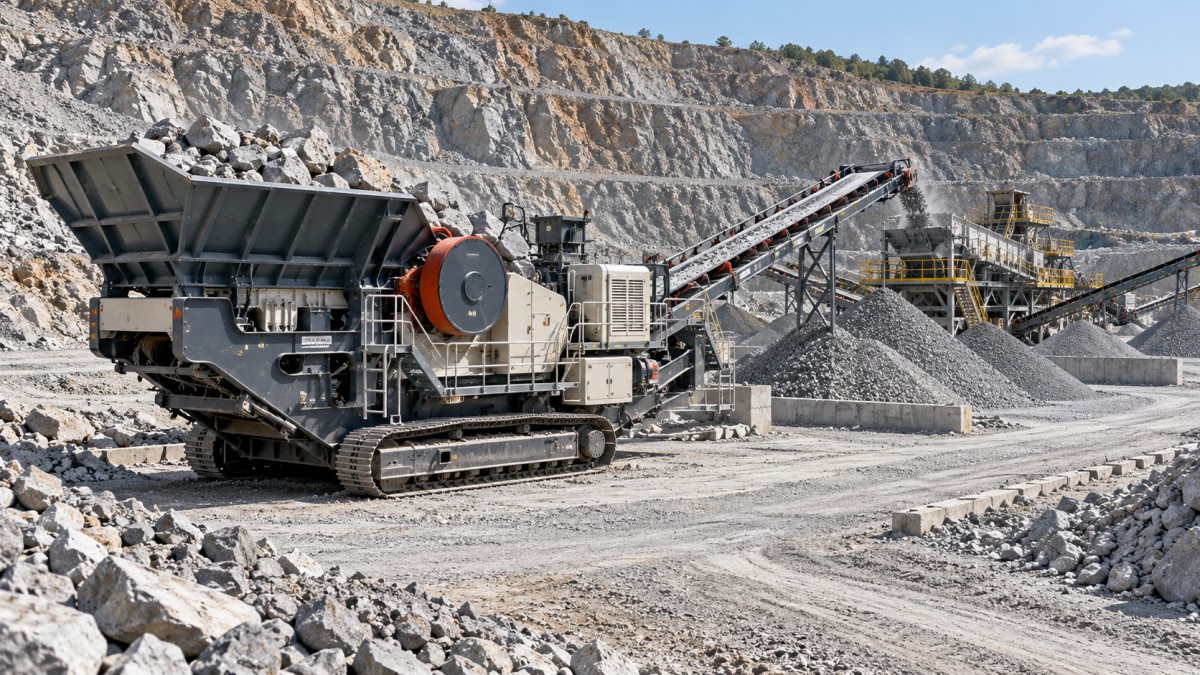
When should quarries choose mobile industrial crushing solutions?
auth.Rock Comminution ExpertTime
Oct 28, 2026Click Count
Quarries should choose mobile industrial crushing solutions when moving the processing plant closer to extraction materially reduces hauling, when production must start before permanent infrastructure is justified, or when separate deposits require equipment to move between locations. The advantage must survive a comparison of saleable output, relocation downtime, wear costs, and site preparation. A plant that travels easily but struggles to produce the required aggregate grading offers little operational value.
Stationary installations remain strong candidates for long-life deposits with stable production requirements, dependable power, and enough volume to justify permanent conveyors, foundations, and stockpiling systems. Between these options, a mobile primary crusher feeding a fixed downstream plant often deserves consideration.
Start with the movement of rock through the quarry
The strongest case for mobility usually begins with the quarry development plan. As an extraction face advances, the haul distance to a fixed primary crusher grows. Longer cycles tie up trucks, increase road maintenance, and expose production to congestion. Moving the primary crusher closer to the face changes that material flow, especially when crushed rock can leave through conveyors instead of returning to the same truck fleet.
However, a shorter face-to-crusher route does not automatically reduce total transport effort. Secondary crushing, screening, and finished-product storage still need space. If every relocation pushes stockpiles farther from the loading area, savings at the quarry face can be absorbed by additional loader movements and product haulage.
Compare complete routes for representative stages of quarry development: newly opened benches, the expected middle of the extraction sequence, and later working areas. Include empty truck returns, queuing, loading time, conveyor transfers, and stockpile handling. Mobility has a measurable advantage when it removes recurring material movement across enough production hours to repay each relocation.
A crawler-mounted crusher is also not a substitute for a suitable working area. Ground bearing capacity, drainage, bench width, edge protection, and access for service vehicles determine where the machine can operate. Frequent repositioning becomes less attractive when each location requires extensive earthworks.
Match the crushing circuit before choosing its mounting arrangement
Rock characteristics and product requirements determine the process. Tracks, wheels, and transport dimensions come afterward. A mobile unit using the wrong crushing mechanism will retain the same limitations wherever it moves.
For hard, abrasive feed, a jaw primary followed by cone crushing is a common starting point. An impact crusher can offer useful reduction and particle shaping in suitable rock, but abrasive minerals increase wear exposure. Rock names alone provide insufficient guidance: mineral composition, abrasive content, strength, weathering, and the proportion of fines all affect performance.
Feed size deserves particular attention. A crusher opening describes an entry geometry; it does not guarantee reliable handling of every lump that appears to fit. Slabby pieces can bridge, while oversized blocks interrupt feeding or require secondary breaking. Blast fragmentation and excavator loading practices therefore belong in the equipment evaluation.
Variable geology strengthens the argument for a reconfigurable mobile circuit only when the available machines can handle that variation. Adjusting a closed-side setting cannot compensate for clay that blinds a screen or feed that requires a different crushing mechanism. Sticky overburden contamination may require scalping, separate handling, or a wet processing stage, each with additional space and utility requirements.
Product specifications can outweigh relocation benefits. Tight grading limits and demanding particle-shape requirements may need multiple crushing stages, controlled recirculation, and sufficient screening area. A compact mobile train becomes less compact once return conveyors, surge storage, and separate product stockpiles are included.

Compare saleable tonnes rather than headline capacity
Published capacity figures require a stated feed and operating basis. Material density, moisture, feed grading, crusher settings, and liner condition all influence achievable throughput. The useful comparison is the quantity of compliant product produced over the available operating period, including interruptions and changes in feed.
A primary crusher can appear comfortably sized while the final screen limits the entire circuit. In closed circuit, oversize returns consume crusher and screen capacity repeatedly. A tighter product cut or wetter feed can increase that circulating load, reducing fresh-feed capacity even when the crusher itself has spare power.
Request a mass balance showing fresh feed, recirculating material, and each finished fraction under the expected operating conditions. The balance should reveal what happens when one fraction has weak demand: continued production may require extra storage, a changed product split, or a reduced feed rate.
Direct loading into a mobile hopper also creates an intermittent feed pattern. Excavator cycle time, repositioning, and inconsistent bucket loads influence crusher utilization. A suitable feeder and adequate buffering help stabilize production, but the whole train still needs coordinated controls. If one downstream conveyor stops, the response must prevent upstream machines from overfilling chutes or discharging into a blockage.
Performance comparisons should use an agreed product envelope: grading, particle shape where relevant, contamination limits, and acceptable moisture conditions. Otherwise, a circuit producing a coarser or less tightly controlled product may appear more productive simply because it performs less processing.
Decide how much mobility the site actually needs
Relocation frequency should follow the extraction sequence rather than an assumption that mobile equipment must move often. Moving too frequently sacrifices production time; moving too late allows haul distances to grow. The relocation decision occurs when the expected haulage saving before the next move exceeds shutdown, preparation, transfer, and restart costs.
Transportability between sites requires separate verification. Operating weight and transport weight differ when conveyors, screens, or other components must be removed. Overall dimensions, axle loads, available lifting equipment, and route restrictions determine whether a nominally mobile plant can transfer economically.
Power and maintenance access can change the preferred option
Diesel-powered equipment offers independence from a fixed electrical connection, which supports remote or temporary working areas. Its evaluation still needs realistic fuel consumption across the entire train, including idling and auxiliary equipment. Engine service, fuel delivery, and cooling-system cleaning add to the operating requirement.
Grid-powered mobile equipment becomes attractive where electrical supply can follow the plant at reasonable cost. Cable routing, protection from vehicle traffic, connection capacity, and the time needed to relocate electrical infrastructure belong in the layout. Electric drive does not make relocation frictionless, and a weak supply can restrict production.
Where dual-power operation is offered, verify which functions operate from each power source. Propulsion, crushing, conveyors, and auxiliary systems do not necessarily share the same arrangements. Comparisons should reflect the intended operating mode rather than assuming equivalent performance in every configuration.
Maintenance space is equally consequential. Compact packaging can restrict access around liners, screens, drives, and hydraulic components. Confirm how wear parts leave the machine, where lifting equipment stands, and whether replacement work requires dismantling adjacent conveyors. A machine positioned tightly against a bench may fit the production layout while leaving insufficient room for servicing.
Evaluate wear on a cost-per-saleable-tonne basis, including replacement labor and lost operating time. Liner life by itself is incomplete evidence: a longer-lasting profile that reduces throughput or changes product grading can worsen the overall result. Dust control, safe isolation, and access for blockage clearance must remain workable at every planned operating position.
Build the economic comparison around the quarry schedule
Mobile equipment often reduces the need for permanent civil construction and allows capacity to enter service in stages. Those advantages are particularly relevant to short production campaigns, uncertain reserve development, or temporary aggregate demand. They do not establish a universal capital or operating cost advantage; a complete mobile circuit can involve several machines and substantial supporting infrastructure.
Use a common boundary for every option. Include the loader or excavator, haul trucks, conveyors, power supply, water provision, working platforms, stockpile handling, maintenance, and relocation. Compare the same finished products over the same production schedule.
A useful decision measure is:
Cost per saleable tonne = total relevant ownership and operating costs over the evaluation period ÷ compliant tonnes available for sale during that period.
Account consistently for residual equipment value and the timing of major expenditure. Avoid dividing costs by nominal crusher capacity multiplied by scheduled hours: that calculation hides downtime, unsaleable fractions, weather interruptions, and demand constraints.
Sensitivity analysis is most useful when it targets conditions that could reverse the selection. Test a longer campaign at one location, slower face advance, higher wear consumption, reduced electrical availability, and a tighter final product specification. If mobile equipment wins only under frequent relocation and unusually favorable availability, the investment depends on assumptions that need stronger evidence.
Use a production trial to resolve the remaining uncertainty
A representative trial should include the material that challenges the proposed circuit, alongside normal feed. Weathered bands, wet fines, abrasive zones, and changes in fragmentation reveal different limitations. A short run on clean, evenly sized rock establishes little about sustained quarry performance.
Record feed conditions, crusher settings, power or fuel use, product grading, recirculating load, stoppages, and the reason for each interruption. Measure stockpile quantities with an agreed method so that fresh feed, internal returns, and finished production are not confused. Wear observations need enough operating exposure to support any projection; a brief demonstration cannot establish liner life.
The trial should also expose the relocation work: disconnecting transfers, preparing the next platform, moving equipment, restoring utilities, and restarting stable production. Mobile industrial crushing solutions earn their place when these measured operating and relocation results support the quarry development schedule and required product output.
Recommended News
- 00
0000-00
When should quarries choose mobile industrial crushing solutions?Discover when mobile industrial crushing solutions help quarries cut haulage costs. Compare saleable output, relocation downtime, and operating costs to choose the right setup. - 00
0000-00
When does a tracked crusher make sense for industrial rock crushing?Industrial rock crushing equipment: learn when a tracked crusher reduces haulage, improves flexibility, and delivers stronger project economics. - 00
0000-00
Which wind load engineering standards apply to mobile crushers?Wind load engineering standards for mobile crushers: compare Eurocode, ASCE 7 and regional codes, verify configurations, site conditions, and safe operating limits.
000000-00
{item.title}{item.description}Search News
Industry Portal
Hot Articles
- How heavy industry trends are shaping mining capital investmentExplore how heavy industry trends influence mining capital investment, from electrification and automation to lifecycle costs and resilient procurement.
- Indonesia Calls for Stronger Mining Accountability Ahead of Minerba Convex 2026Indonesia mining accountability takes center stage at Minerba Convex 2026. Explore the compliance and sustainability issues shaping industry discussions.
- Cost optimization analysis for deciding when to automate mine haulageUse cost optimization analysis to decide when mine haulage automation pays off. Compare lifecycle costs, productivity gains, and break-even thresholds to invest with confidence.
Popular Tags