How feed moisture affects screening efficiency in aggregate processing
auth.Rock Comminution ExpertTime
Oct 18, 2026Click Count
How feed moisture affects screening efficiency in aggregate processing
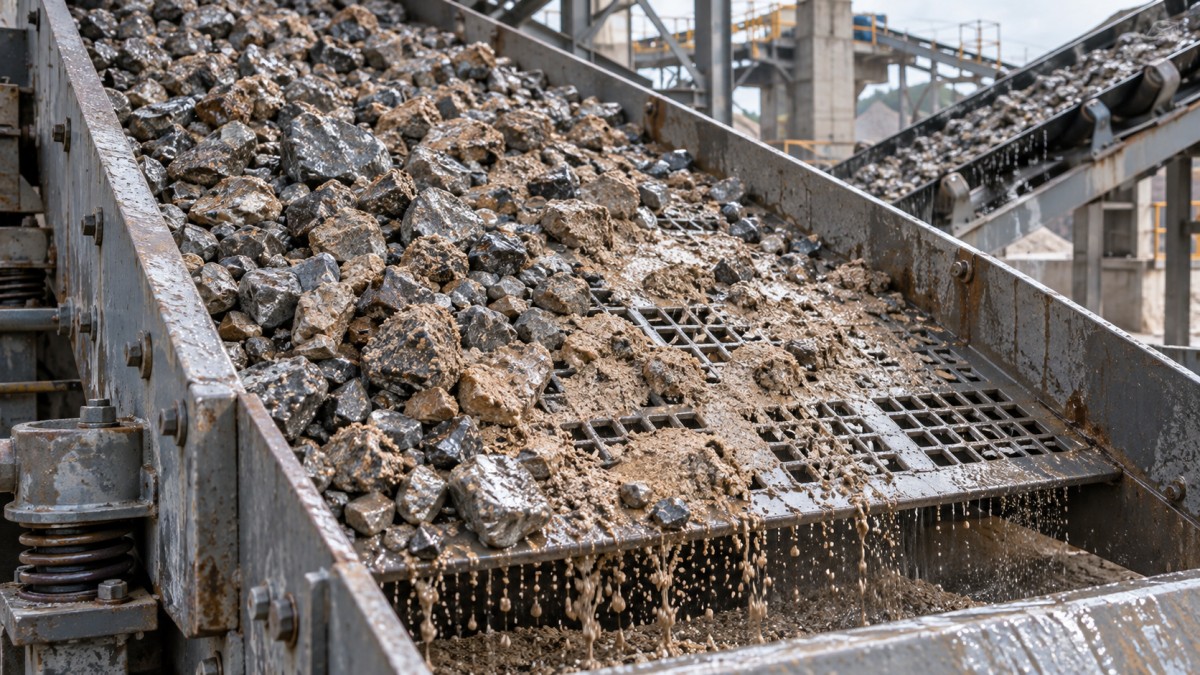
Feed moisture can turn a well-sized aggregate screen into a production bottleneck, increasing particle adhesion, aperture blinding, and misplaced fines. In industrial material processing for aggregates, understanding this relationship is essential to assessing throughput, separation accuracy, and downstream product quality. Yet water content alone does not explain performance: clay mineralogy, particle size distribution, screen media, and operating conditions all influence the outcome.
The practical question is not simply whether the feed is wet. It is whether moisture prevents particles from separating and reaching an open aperture—and whether the process should remove that moisture, tolerate it, or deliberately add enough water to support wet screening.
Why damp feed behaves differently on a screen
Dry screening relies on bed stratification. Smaller particles work down through larger material, contact the deck, and pass through suitable openings. Water can interrupt each stage. Liquid bridges between particles promote agglomeration, fines stick to coarse stone, and cohesive material moves across the deck as clusters rather than individual grains.
An undersize particle attached to a larger rock may therefore report to the oversize stream without ever reaching an aperture. Meanwhile, sticky fines coat the screening surface and progressively reduce its effective open area. The screen may still transport material, but it is no longer separating it as intended.
Distinguish blinding, where material covers or obstructs openings, from pegging, where individual near-size particles lodge in them. Both reduce available screening area, but the remedies differ. Flexible media may help release pegged particles; persistent clay coating may require washing, scrubbing, or feed management.
The relationship is not linear. Moderately damp material can be harder to screen than either dry feed or a properly dispersed wet-screening feed. Adding a little water may worsen adhesion; adding sufficient controlled process water can help transport fines through the deck. There is no universal moisture percentage at which that transition occurs.

The moisture number needs a material description
Two feeds with the same measured moisture can behave very differently. Clean crushed rock with few fines may remain relatively free-flowing, while clay-bearing material becomes cohesive. Some water is absorbed inside porous particles; some remains on their surfaces. Total moisture testing does not, by itself, describe the water available to create adhesion.
Fine cuts are particularly sensitive because surface forces become more influential relative to particle weight as size decreases. A feed rich in near-aperture material also demands more screening opportunities. Combine that size distribution with sticky fines and a deep bed, and nominal deck area becomes a poor predictor of actual capacity.
Record moisture alongside the feed grading, fines content, clay characteristics, target aperture, and bulk flow behavior. Where clay contamination is significant, additional characterization may be necessary: the mass of fine material alone does not establish how strongly it coats stone or responds to washing.
State the moisture basis explicitly. Wet-basis moisture is water mass divided by total wet mass; dry-basis moisture is water mass divided by dry solids mass. Confusing these bases distorts capacity calculations and supplier comparisons. Screen loading should be evaluated on a dry-solids basis, with water loading considered separately.
Measure separation, not just tonnes crossing the deck
A belt scale can show steady output while product grading deteriorates. When fines remain attached to oversize, apparent screen throughput may stay acceptable even though useful separation has fallen. Increased moisture also raises wet tonnage without necessarily increasing saleable solids production.
For a stated cut size, one useful measure is undersize recovery: the dry mass of below-cut material recovered in the undersize stream divided by the dry mass of below-cut material entering with the feed. Pair this with oversize contamination in the undersize product and residual fines in the coarse product. “Screening efficiency” should never appear in an acceptance specification without its calculation method.
Collect representative feed and product samples over the same stable operating period, accounting for transport delays. Reconcile dry-solids flows before interpreting the result. Poor mass-balance closure can indicate sampling error, changing feed conditions, or an unmeasured stream rather than a screen problem.
A practical monitoring set includes dry-solids feed rate, moisture, feed grading, product grading, blocked deck area, bed depth, and cleaning downtime. Trends across rain events or stockpile changes are more informative than a single favorable test.
Use laboratory standards for their intended purpose
ASTM C566 addresses total evaporable moisture content of aggregate by drying. ASTM C136/C136M covers sieve analysis of fine and coarse aggregates, while ASTM C117 addresses material finer than the 75-micrometre sieve by washing. These methods can support consistent characterization, subject to the applicable edition and project specification; they do not establish a universal operating moisture limit for an industrial screen.
Washed and dried laboratory results describe particle-size distribution after preparation, not necessarily the agglomerates arriving on the production deck. Preserve observations of the as-fed condition alongside laboratory data. Otherwise, sample preparation can remove the very adhesion mechanism under investigation.
Choosing between dry-screening adjustments and a wet circuit
Start with the source of the problem. Localized blinding beneath a poorly distributed feed is different from widespread clay coating. Uneven loading, excessive bed depth, worn media, or incorrect motion can make moisture appear to be the sole cause when it is only one contributor.
Media selection is a trade-off, not a ranking. Wire cloth can provide substantial open area, while polyurethane or rubber may offer useful wear and flexibility characteristics in suitable applications. Actual performance depends on panel construction, aperture geometry, support layout, and material behavior—not simply the media label.
Do not increase vibration indiscriminately. Changes to stroke, frequency, or deck angle affect transport speed, stratification, residence time, and structural loading. Adjustments should remain within the equipment manufacturer's limits and be assessed against separation quality, not only visible material movement.
Wet screening moves the constraint elsewhere
A wet screen requires more than spray bars. Water must reach the material bed with suitable coverage, while the deck and undersize handling system must accommodate the combined solids and liquid flow. Spray pressure alone is not a reliable design criterion; nozzle condition, flow, arrangement, and bed penetration also matter.
Water quality matters too. Recirculated water carrying substantial suspended fines may change washing performance, nozzle maintenance, and product cleanliness. Some clays resist simple rinsing and require mechanical attrition before a screen can separate the liberated particles.
Evaluate pumps, sumps, fines recovery, clarification, sludge handling, and product dewatering as one circuit. Check water availability and applicable discharge or abstraction requirements locally. A screen that achieves the required grading can still be an unsuitable solution if the site cannot manage the resulting water and fines.
Downstream consequences belong in the comparison. Retained product moisture affects stockpile drainage, aggregate moisture correction at concrete batching plants, and the drying load at asphalt plants. Better separation does not automatically mean lower whole-plant cost.
Specify a feed envelope and prove it under variable conditions
An equipment evaluation should define expected and adverse feed conditions rather than one average moisture value. Include dry-solids throughput, moisture basis, particle-size distribution, near-size fraction, clay characteristics, required product grading, and operating hours. For wet options, add process-water conditions and acceptable discharge moisture.
Trials should represent meaningful feed variability and run long enough to reveal progressive coating or blinding. A short demonstration on a clean deck can conceal a gradual loss of open area. Record cleaning interventions and inspect the screen safely under approved isolation procedures; never treat manual clearing near operating equipment as a normal performance allowance.
Compare alternatives by saleable dry tonnes meeting specification, including recirculating load, water treatment, maintenance, and downtime. This connects screening decisions with the broader equipment and lifecycle-cost analysis covered by Global Heavy Infrastructure & Earthmoving Systems (HIES), rather than treating the screen as an isolated machine.
Before accepting a capacity guarantee, confirm which moisture range, feed grading, clay condition, and efficiency definition it covers. The useful guarantee is not that material will cross the deck. It is that the specified feed can be separated into compliant products without unacceptable cleaning, wear, or downstream penalties.
Next:Already The FirstRecommended News
- 00
0000-00
How feed moisture affects screening efficiency in aggregate processingImprove industrial material processing for aggregates. Discover how feed moisture affects screening efficiency and explore practical ways to reduce blinding and boost product quality. - 00
0000-00
How to size an aggregate processing system for peak feed ratesAggregate processing system sizing for peak feed rates: learn how to balance material flow, surge, screening, and uptime for reliable saleable output. - 00
0000-00
High-Frequency Screening Technology: How to Improve Efficiency in Fine Material SeparationHigh-frequency screening technology efficiency explained: discover how to boost fine material separation, improve product quality, cut recirculation, and lower operating costs.
000000-00
{item.title}{item.description}Search News
Industry Portal
Hot Articles
- How feed moisture affects screening efficiency in aggregate processingImprove industrial material processing for aggregates. Discover how feed moisture affects screening efficiency and explore practical ways to reduce blinding and boost product quality.
- When does heavy equipment electrification pay off for mining fleets?Explore heavy equipment electrification benefits for mining fleets. Learn how energy costs, charging, and battery life affect payback—and find out when your investment makes sense.
- Which project costs does a mining equipment price list leave out?A mining equipment price list rarely covers the full project cost. Uncover hidden freight, site setup, maintenance, and downtime expenses to compare quotes and budget with confidence.
Popular Tags