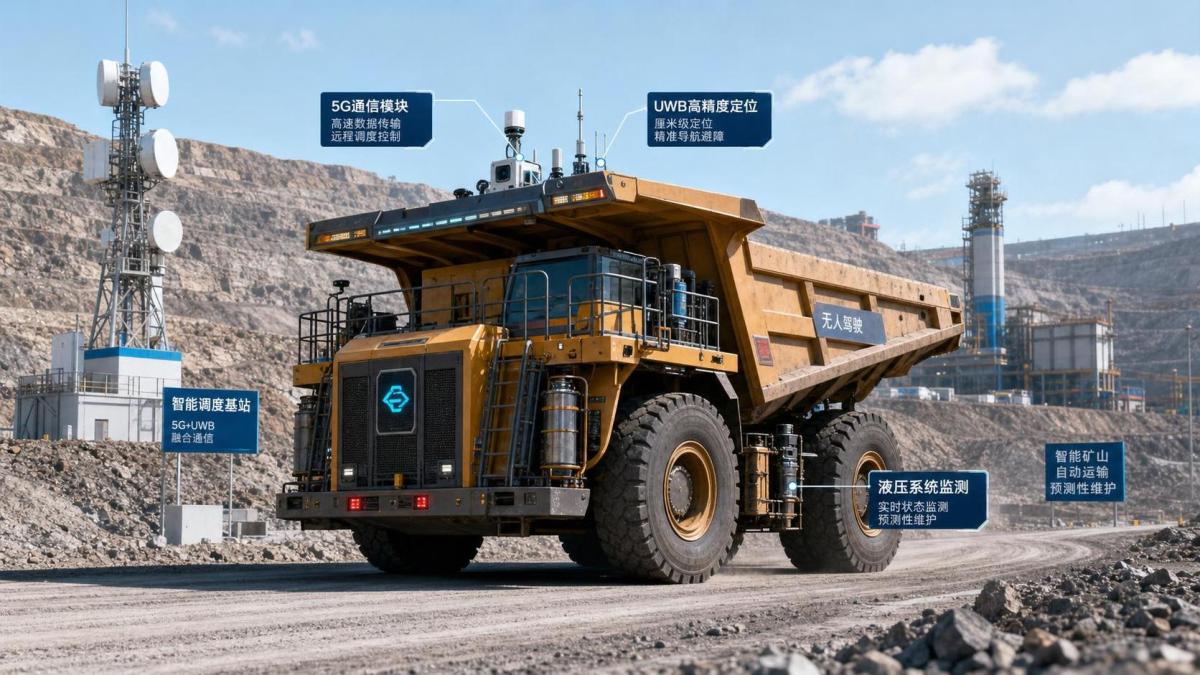
Codelco AHS Tender Raises 5G+UWB Requirements
auth.Heavy Haulage StrategistTime
Jul 03, 2026Click Count
On July 2, 2026, Chilean state-owned copper producer Codelco issued a second-phase Autonomous Haulage System upgrade tender that sets unusually specific technical conditions for mining trucks, including 5G NR-U communications, centimeter-level UWB positioning, and remote diagnostic data flows for predictive maintenance analysis. For truck OEMs, fleet technology suppliers, dispatch platform providers, and mining service teams, the announcement is worth close attention because it shows that connectivity, positioning, and cloud-based equipment health data are being written directly into fleet procurement requirements rather than treated as optional add-ons.

What the tender explicitly requires
According to the provided event summary, Codelco released the AHS phase-two upgrade tender under Ref: CDEL-AHS-2026-07 on July 2, 2026. The tender requires bidding mining trucks to integrate 5G NR-U communication modules and UWB positioning systems capable of centimeter-level accuracy.
The same summary states that the trucks must support real-time upload of hydraulic system fatigue parameters to the cloud for Rock Mechanics & Fatigue predictive maintenance analysis. It also specifies that the winning equipment must complete both MSHA and UNECE R156 certification by Q1 2027.
The project scope covers 27 new AC/DC drive mining trucks together with a supporting dispatch platform.
Where the impact is likely to be felt first
Truck and vehicle-system suppliers face a tighter integration threshold
From an industry perspective, truck manufacturers and onboard system integrators are the first group likely to feel the effect of this tender structure. The requirement is not limited to haulage autonomy alone; it links communications hardware, high-precision positioning, and equipment-health data transmission into a single eligibility framework. In practical terms, affected business stages are likely to include vehicle configuration, system integration, compliance preparation, and bid documentation.
What deserves closer attention is whether suppliers can present these capabilities as an already integrated package rather than as separate modules that still require later adaptation.
Dispatch and connectivity vendors may see higher expectations around interoperability
Analysis shows that dispatch platform providers and industrial connectivity vendors may be affected through the need to work across the truck, the positioning layer, and the cloud diagnostic workflow. Because the tender covers both trucks and the supporting dispatch platform, the commercial focus is likely to shift toward interoperability and operational data continuity.
The key business impact here is less about adding one more feature and more about proving that communications, location data, and fleet coordination can operate together under procurement-grade requirements.
Maintenance and reliability teams may be pulled closer into procurement decisions
Observably, the requirement to upload hydraulic fatigue parameters in real time for Rock Mechanics & Fatigue predictive maintenance analysis gives maintenance-related functions a more direct place in the equipment selection process. For service providers and internal technical teams, the impact is likely to appear in diagnostic data handling, maintenance planning, and support model design.
This matters because the tender language connects fleet hardware selection to downstream maintenance analytics, which can change how responsibilities are divided between operations, maintenance, and digital service partners.
What companies should monitor before the project moves further
Whether technical language becomes more detailed in follow-up documents
Companies tracking this tender should closely watch for any subsequent official clarification on how the 5G NR-U, UWB, and cloud diagnostic requirements are to be interpreted in implementation terms. Analysis shows that broad technical labels in a tender can later be narrowed through annexes, compliance notes, interface requirements, or acceptance conditions.
How certification timing aligns with delivery planning
The requirement for MSHA and UNECE R156 certification by Q1 2027 deserves practical attention. For bidders and supply-chain partners, the issue is not only whether certification is achievable, but whether the certification timeline fits procurement commitments, integration work, and customer communication. This is especially relevant for teams preparing bid schedules, technical files, and cross-border compliance materials.
Whether suppliers can document data-readiness, not just hardware readiness
From a commercial preparation standpoint, it is reasonable to focus on documentation around real-time data upload, hydraulic fatigue parameter handling, and the link to predictive maintenance analysis. The tender summary indicates that data flow is part of the requirement set, so suppliers may need to prepare not only product specifications but also supporting material that explains how diagnostic information can be captured and transmitted within the required framework.
How integrated proposals are structured across trucks and platform support
Because the project includes 27 AC/DC drive mining trucks and a supporting dispatch platform, companies should pay attention to proposal structure, partner coordination, and interface responsibilities. Observably, bids that treat the truck, communications layer, positioning layer, and dispatch environment as disconnected work packages may face higher execution risk than those that define clearer system boundaries and accountability upfront.
Why this reads as a procurement signal, not just a single tender
Analysis shows that the immediate fact pattern is still limited to one published tender and its stated requirements, so it would be premature to describe this as a settled market shift. Even so, the wording is notable because it places 5G NR-U, UWB high-precision positioning, and cloud-based fatigue diagnostics inside the core specification set for autonomous haulage equipment.
It is more appropriate to understand this as a strong procurement signal with possible longer-term implications, rather than as proof that the broader mining equipment market has already standardized around the same stack. The next point to watch is whether similar requirement language appears again in follow-on procurements, vendor responses, or implementation criteria tied to this project.
How to read the development for now
At this stage, the Codelco tender is best read as an indicator that some mining buyers are formalizing digital and diagnostic capability requirements at the fleet procurement level. The confirmed facts do not yet show award results, deployment outcomes, or wider market adoption. Still, for OEMs, platform providers, and service firms active around autonomous haulage, the announcement is relevant because it links vehicle eligibility to communications, positioning, predictive maintenance data, and certification readiness in one package.
In that sense, the development is neither a routine equipment refresh nor a basis for broad market conclusions. It is better understood as a concrete near-term procurement event with wider strategic signals that still need continued verification through later disclosures and project execution milestones.
Basis of this report and what still needs verification
This article is based on the user-provided news title, event date, and event summary related to Codelco's AHS phase-two upgrade tender dated July 2, 2026. For this type of industry update, commonly relevant source categories may include official tender notices, company announcements, industry association materials, authoritative media coverage, and standards or certification-related documents.
No specific official source link was provided in the input, so the precise original publication link remains to be verified on an ongoing basis. Follow-up attention should focus on any official clarification to the tender requirements, later procurement-stage disclosures, certification progress, and any confirmed implementation details for the 27-truck and dispatch-platform scope.
Recommended News
- 00
0000-00
China Tightens AHS Export ComplianceChina tightens AHS export compliance with new type testing and customs filing rules. Learn how autonomous haulage system exporters can avoid delays, protect delivery schedules, and stay compliant. - 00
0000-00
EU Requires EN 50126-3 for AHS Mining Trucks from Oct 2026EN 50126-3 becomes essential for AHS mining trucks entering the EU from Oct 2026. Learn compliance impacts, CE documentation risks, and how suppliers can prepare faster. - 00
0000-00
Australia Sets AHS Safety Certification RuleAustralia Sets AHS Safety Certification Rule: Learn how AS 61508:2026 Ed.3 and SIL2 requirements will impact AHS exports, approvals, delivery timelines, and market access in Australia.
000000-00
{item.title}{item.description}Search News
Industry Portal
Hot Articles
- What to check before choosing an aggregate production line manufacturerChoose an aggregate production line manufacturer with confidence. Explore key checks for capacity, product quality, layout, service, lifecycle cost, and reliable project delivery.
- When does open-pit mining fleet electrification cut haulage costs?Mining Fleet Electrification open pit: learn when electrified haulage lowers cost per tonne through reliable power, stable routes, high utilization and smarter charging.
- How TBM cutterheads should match abrasive rock conditionsTBM Cutterheads for abrasive rock: learn how geology, cutter layout, wear protection, muck flow, and maintenance strategy improve tunnelling reliability.
Popular Tags