Codelco Tenders Add ISO 50001 Interface Rule
auth.Paving Materials FellowTime
Jul 09, 2026Click Count
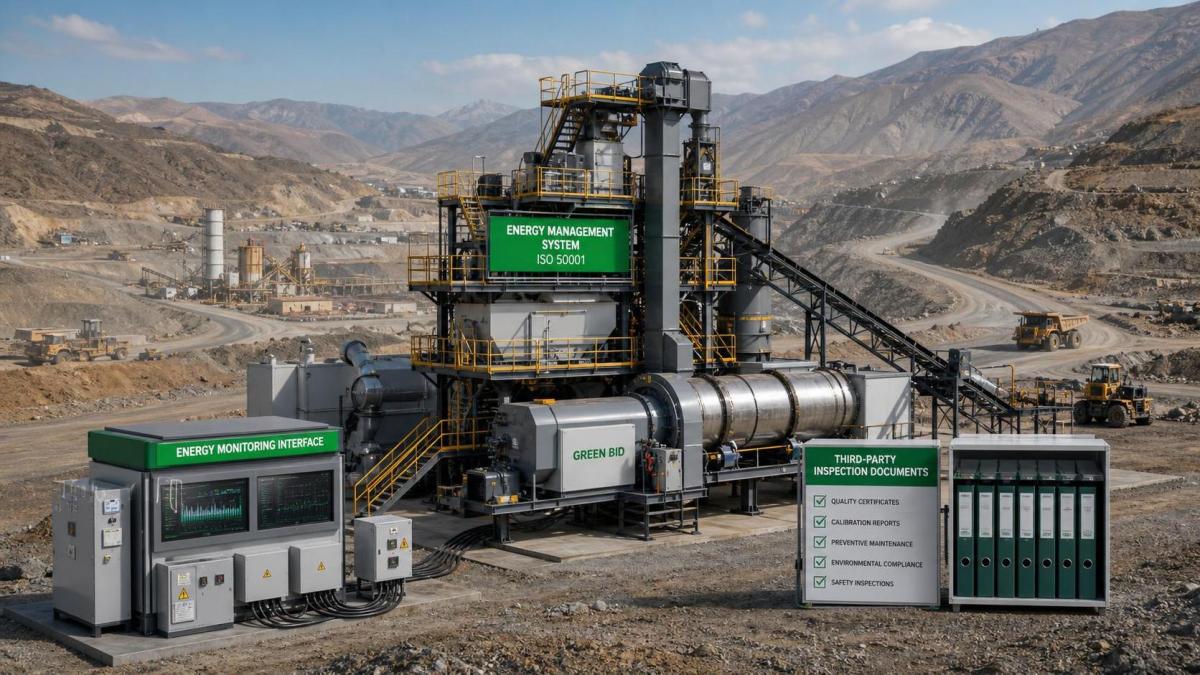
On July 8, 2026, Chile's Ministry of Mining and Codelco issued a supplemental green procurement guideline for the second half of 2026 that changes bid access conditions for continuous asphalt plants used in mining-area road rehabilitation EPC work. The update matters because it does not simply add a general sustainability statement; it ties equipment eligibility and bid evaluation to a preinstalled ISO 50001 energy management system data interface and a third-party energy efficiency verification report, creating immediate compliance implications for equipment suppliers, exporters, distributors, technical documentation teams, and project procurement participants.

What the new tender condition clearly requires
The confirmed facts are limited but clear. The Ministry of Mining of Chile and Codelco released the Supplementary Guidelines for Green Procurement in Infrastructure EPC for H2 2026 on July 8, 2026. Under that document, all continuous asphalt plants participating in the relevant tenders must have a preconfigured ISO 50001 energy management system data interface and must provide a third-party energy efficiency verification report. The requirement applies to road repair projects in major Codelco mining areas including Andina and El Teniente. The summary also states that the requirement directly affects both equipment access qualification and bid scoring weight.
The same summary further confirms that this creates a new technical compliance obligation for Chinese exporters of this category of equipment. It also gives overseas distributors a clearer basis for assessing the green qualification of suppliers.
Where the impact is likely to appear first
Bid qualification now begins at the equipment interface level
From an industry perspective, manufacturers and exporters of continuous asphalt plants may be affected first because the rule is framed as a tender entry condition rather than a later operational preference. The practical pressure point is no longer only plant performance in a general sense, but whether the equipment is prepared to connect with an ISO 50001 energy management framework and whether the supporting verification materials are available at bid stage.
That means affected companies should pay closer attention to technical specifications, bid-response documentation, interface readiness descriptions, and the consistency between product configuration and submitted compliance materials.
Procurement teams face a stricter screening task
For project owners, EPC procurement teams, and channel partners involved in supplier selection, the rule raises the importance of pre-bid screening. The change is relevant because eligibility and scoring are both affected. In practice, buyers and intermediaries may need to review not only price and production capability, but also whether the supplier can demonstrate the required interface setup and present a valid third-party energy efficiency verification report in a form acceptable for tender review.
What deserves closer attention is the procurement workflow itself: supplier qualification checks, technical bid alignment, and document completeness may become more decisive than before in early-stage tender participation.
Distributors and service partners may need a different supplier filter
For overseas distributors and after-sales or local support partners, the summary indicates a clearer benchmark for evaluating green qualification. Analysis shows this may affect supplier onboarding, product portfolio decisions, and project-specific recommendation practices. A distributor that previously focused mainly on delivery capability or market familiarity may now need to verify whether the upstream manufacturer can support ISO 50001-related data interfacing and provide third-party efficiency evidence without delaying tender preparation or delivery coordination.
Verification and documentation providers gain a more visible role
Certification-related firms, testing bodies, and technical documentation service providers may also see a more direct role in this process. The requirement for a third-party energy efficiency verification report means documentation is not merely supportive background material; it may become part of the file set that influences market access and bid competitiveness. Even so, the exact review format, document threshold, and acceptance practice are not detailed in the provided information and should not be treated as settled.
What companies should review now
Check whether product configuration already supports the required interface
Analysis shows the first practical question is whether the continuous asphalt plant being offered already includes a preinstalled ISO 50001 energy management system data interface, or whether this would require redesign, software adaptation, control-system changes, or additional integration work. Companies involved in export offers or distributor supply should verify this before technical bids are prepared.
Re-examine the readiness of verification materials
The second issue is document readiness. Because a third-party energy efficiency verification report is explicitly required, companies should review whether their current technical file set includes relevant verification material and whether internal teams can align those materials with tender submission timelines. At this stage, it is more appropriate to understand this as a compliance preparation issue rather than a confirmed rejection pattern, because the provided information does not include actual tender-case outcomes.
Watch tender wording and execution language closely
Observably, the published signal is strong, but the market still needs to watch how the requirement is expressed in individual tender documents, technical annexes, and evaluation language. Companies should therefore monitor whether future bid packages clarify interface specifications, documentation format, review criteria, or timing requirements for verification evidence. Those details will shape how demanding the rule becomes in actual execution.
Factor compliance into delivery and partner coordination
For exporters, distributors, and service partners, the issue is not limited to tender paperwork. If the interface requirement affects equipment configuration, factory testing, or final handover documentation, it may also influence delivery planning and supplier coordination. Current attention should therefore include communication between manufacturing, sales, compliance, and local project support teams so that a bid promise can be matched by deliverable configuration.
How this signal should be read at this stage
Analysis shows this development is best read as a concrete procurement execution signal rather than a general policy slogan. The requirement is linked to specific equipment, specific documentation, and identifiable project application within Codelco mining areas. That gives it practical weight.
At the same time, it should not yet be overstated as a fully mapped market-wide enforcement pattern. The provided information confirms the new requirement and its relevance to qualification and scoring, but it does not provide the full downstream detail on review standards, acceptance thresholds, or implementation feedback. For that reason, industry participants should treat this as a landed compliance change with follow-up execution points still worth tracking.
Why the market should keep this in view
The broader significance of this update lies in how a procurement rule is being translated into equipment-level technical compliance. For companies active in continuous asphalt plants for overseas mining infrastructure work, the change is not abstract: it touches bid access, technical documentation, supplier screening, and the credibility of green qualification claims. For now, the most balanced reading is that this is an implemented tender-side requirement with immediate relevance, while the exact execution pathway still needs continued observation through subsequent tender texts and market feedback.
Basis of this article and points still requiring verification
This article is based on the user-provided news title, event date, and event summary. It does not rely on any additional unverified data, external links, or unstated background information. For events of this kind, commonly relevant source categories may include official notices, regulatory releases, trade or customs authority information, industry association updates, standards-related documents, and reporting by established industry media. No specific official source link was provided in the input, so the original publication path still requires follow-up verification.
Further observation is still needed on detailed policy wording, certification and verification acceptance practice, tender document updates, implementation language in project procurement, industry feedback, and how suppliers ultimately respond in actual bid submissions and delivery arrangements.
Recommended News
- 00
0000-00
How Concrete Production Automation Improves Batch Accuracy and Plant ThroughputConcrete production automation improves batch accuracy and plant throughput by optimizing moisture correction, weighing precision, sequencing, and traceability for more consistent, efficient output. - 00
0000-00
How to Evaluate Output Stability in Continuous Asphalt Plants for HighwaysContinuous Asphalt Plants for highways: learn how to judge output stability beyond rated capacity, from cold feed and burner response to controls—choose a plant with confidence. - 00
0000-00
Batching Accuracy Calibration: How Moisture and Scale Drift Affect Mix PrecisionBatching accuracy calibration goes beyond scale checks. Learn how moisture variation and scale drift impact mix precision, quality, and cost—and how smarter control improves results.
000000-00
{item.title}{item.description}Search News
Industry Portal
Hot Articles
- What to check before choosing an aggregate production line manufacturerChoose an aggregate production line manufacturer with confidence. Explore key checks for capacity, product quality, layout, service, lifecycle cost, and reliable project delivery.
- When does open-pit mining fleet electrification cut haulage costs?Mining Fleet Electrification open pit: learn when electrified haulage lowers cost per tonne through reliable power, stable routes, high utilization and smarter charging.
- How TBM cutterheads should match abrasive rock conditionsTBM Cutterheads for abrasive rock: learn how geology, cutter layout, wear protection, muck flow, and maintenance strategy improve tunnelling reliability.
Popular Tags