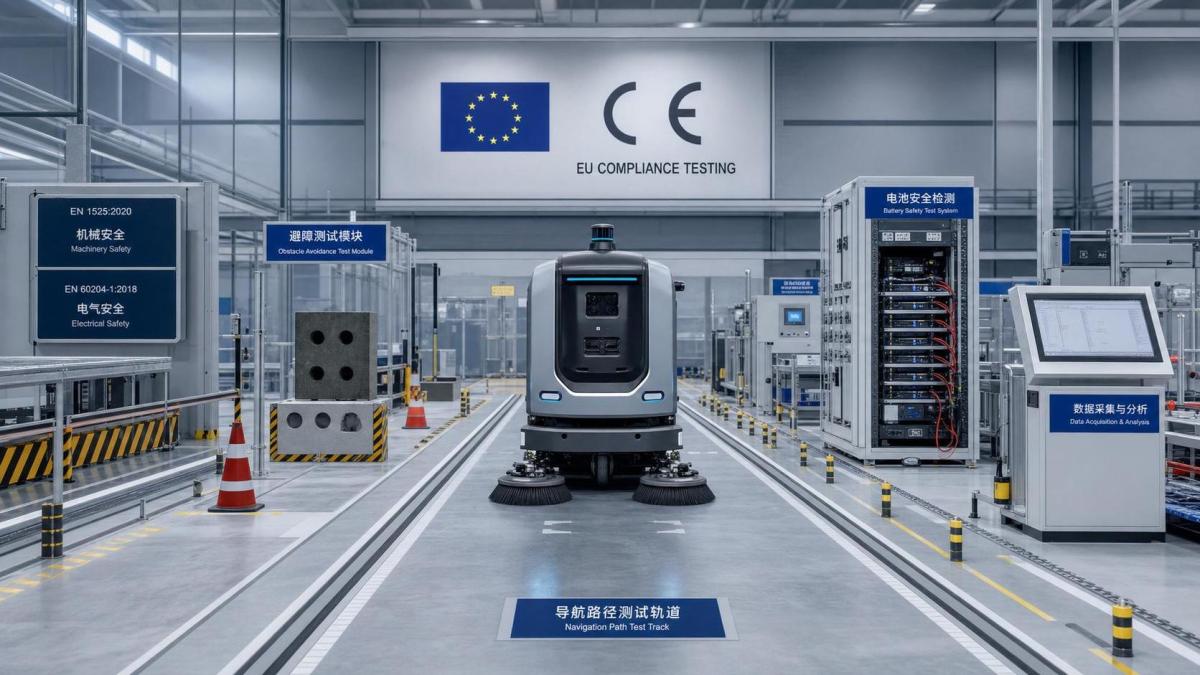
EU Entry Tightens for Autonomous Sweepers
auth.Cleaning Robotics ArchitectTime
Jul 04, 2026Click Count
On July 1, 2026, the EU began mandatory implementation of EN 13462:2026 for industrial cleaning equipment, bringing autonomous cleaning robots within compulsory CE certification where they include path planning, laser SLAM navigation, and automatic obstacle avoidance. For exporters, manufacturers, buyers, and certification-related service providers connected to EV street sweepers, industrial dust sweepers, and autonomous cleaning robots, this is not just a technical update; it directly affects market access, compliance preparation, and type-testing timelines for products bound for the EU.

What the rule now requires
The confirmed change is that, from July 1, 2026, the EU is mandating the updated industrial cleaning equipment safety standard EN 13462:2026. Under this standard, autonomous cleaning robots are expressly included in the scope of mandatory CE certification when they have path planning, laser SLAM navigation, and automatic obstacle avoidance functions.
The standard also adds three core test requirements: dynamic load stability, battery thermal runaway protection, and remote takeover response delay of no more than 200 ms.
The event summary further makes clear that this change directly affects the compliance route and type inspection cycle for Chinese EV street sweepers, industrial dust sweepers, and autonomous cleaning robots exported to the EU.
Where the pressure will show up first
Export programs face a stricter market-access gate
From an industry perspective, exporters are likely to feel the impact first because CE access for covered products now depends on alignment with the updated standard. The immediate business effect is likely to appear in pre-shipment compliance review, technical file preparation, and coordination around type testing. What deserves closer attention is whether current export-ready models already match the newly specified testing items, because any gap could affect shipment timing and acceptance into EU-bound sales channels.
Manufacturing and engineering teams may need to revisit product validation
For manufacturers of EV street sweepers, industrial dust sweepers, and autonomous cleaning robots, the change is relevant not only at the certification stage but also in product verification work. Analysis shows that the added tests on dynamic stability, battery thermal runaway protection, and remote takeover latency are tied to core operating behavior rather than labeling alone. That means engineering documentation, validation records, and test-readiness materials are likely to become more important in the compliance workflow.
Procurement and project delivery may need tighter document control
Buyers, distributors, and supply-chain service providers may also be affected where EU delivery is involved. Observably, once a standard becomes a mandatory gate for entry, procurement review, supplier qualification, and delivery scheduling tend to depend more heavily on whether certification materials and test evidence can be produced in time. In practical terms, affected parties should pay closer attention to product specifications, conformity documentation, and delivery commitments linked to EU projects.
Testing and certification support functions become more time-sensitive
Certification-related firms and testing service providers are likely to see more concentrated demand around scope confirmation, applicable test items, and file review. It is more appropriate to understand this as a workflow issue as much as a regulatory one: when the compliance path changes, type inspection timing and sequencing can become a commercial issue for exporters and their customers.
Practical points companies should review now
Check whether product scope now clearly falls under mandatory CE certification
Analysis shows that companies should first review whether the products they place in the EU market include the functions expressly described in the event summary, especially path planning, laser SLAM navigation, and automatic obstacle avoidance. This scope check matters because it determines whether the updated certification requirement applies directly to a given model.
Re-examine test readiness against the three new core requirements
What deserves closer attention is preparation for the newly added tests: dynamic load stability, battery thermal runaway protection, and remote takeover response delay of 200 ms or less. The input does not provide detailed implementation guidance, so this should not be treated as a settled testing interpretation. Companies should therefore focus on whether their technical documents, internal validation records, and third-party testing plans are sufficient for the revised requirement set.
Adjust timeline assumptions for type inspection and delivery
Because the event summary states that the rule directly affects the compliance route and type inspection cycle, exporters and project teams should review delivery schedules, procurement timing, and customer commitments linked to EU-bound orders. This is especially relevant where market entry depends on completion of formal conformity steps before shipment or tender execution.
Track how the requirement appears in commercial documents
Observably, the next point to watch is how this standard is reflected in tender specifications, procurement documents, customer qualification requests, and after-sales traceability expectations. The current input does not confirm any unified market practice beyond the standard change itself, so companies should treat document updates and customer-side compliance wording as an area that still requires active monitoring.
Why this should be read as an execution signal
Analysis shows that this development is better understood as an implemented compliance change rather than a distant policy discussion, because the effective date is clear and the scope and added test requirements are already identified in the event summary. At the same time, it should not be overstated as a fully settled market outcome. Observably, the practical effect on certification handling, tender language, and delivery rhythm still depends on execution details, certification practice, and feedback from actual transactions.
From an industry perspective, the key takeaway is that this is a rule change with immediate relevance to access, documentation, and testing preparation, while some aspects of market interpretation still need to be watched through implementation.
How the market is likely to frame it for now
It is more appropriate to understand this event as a concrete compliance threshold for EU entry in covered autonomous cleaning equipment, and as a direct signal that certification preparation can no longer be treated as a downstream formality for affected products. The confirmed facts already point to implications for compliance routing and type inspection timing, but the broader commercial impact should still be assessed cautiously as the rule is applied in practice.
Basis of this article and what still needs verification
This article is generated based on the user-provided news title, event date, and event summary. For developments of this kind, commonly relevant source categories may include official notices, regulator publications, customs or trade authority information, industry association updates, standards organization documents, and reporting by authoritative media.
No specific official source link was provided in the input, so the exact official reference path still requires follow-up verification. What remains worth monitoring includes detailed implementation wording, certification enforcement interpretation, changes in tender documents, industry feedback, and how affected companies execute compliance and delivery adjustments in practice.
Recommended News
- 00
0000-00
EU CE Rule Takes Effect for Autonomous Cleaning RobotsEU CE Rule takes effect for Autonomous Cleaning Robots: learn how EN 15692:2026+A1:2026 impacts CE compliance, obstacle avoidance verification, customs timing, and EU export readiness. - 00
0000-00
EU Entry Tightens for Autonomous SweepersEU Entry Tightens for Autonomous Sweepers as EN 13462:2026 makes CE certification mandatory. Learn the new tests, compliance risks, and how exporters can stay EU-ready.
000000-00
{item.title}{item.description}Search News
Industry Portal
Hot Articles
- What to check before choosing an aggregate production line manufacturerChoose an aggregate production line manufacturer with confidence. Explore key checks for capacity, product quality, layout, service, lifecycle cost, and reliable project delivery.
- When does open-pit mining fleet electrification cut haulage costs?Mining Fleet Electrification open pit: learn when electrified haulage lowers cost per tonne through reliable power, stable routes, high utilization and smarter charging.
- How TBM cutterheads should match abrasive rock conditionsTBM Cutterheads for abrasive rock: learn how geology, cutter layout, wear protection, muck flow, and maintenance strategy improve tunnelling reliability.
Popular Tags