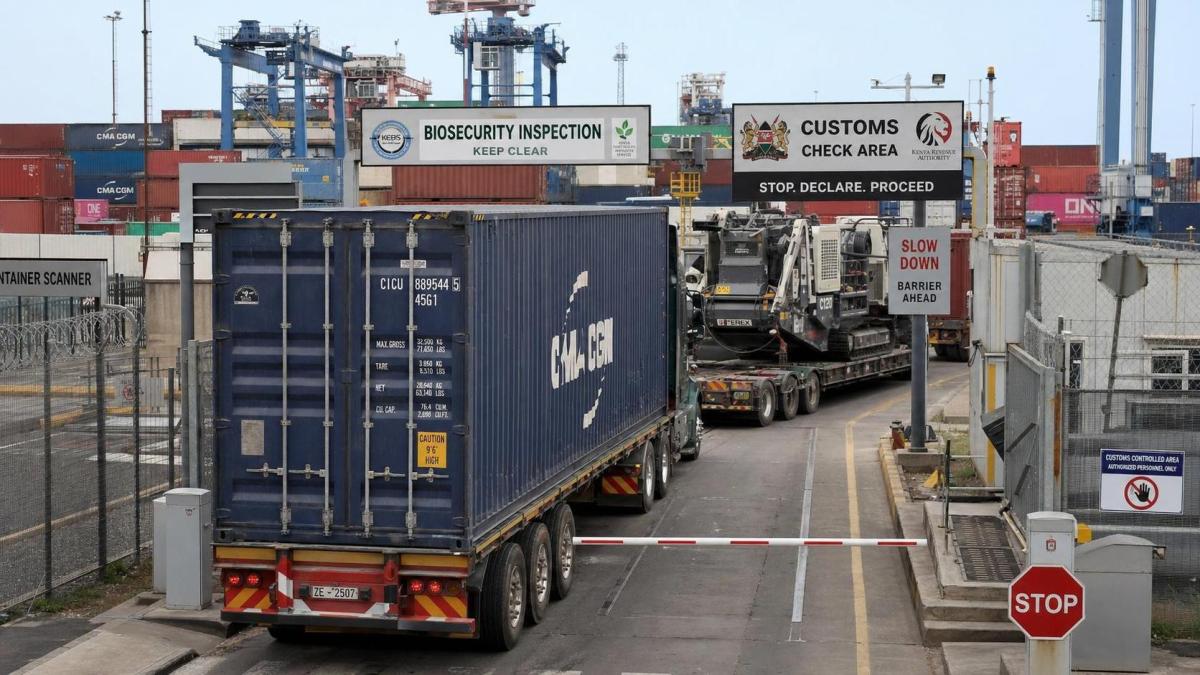
Ebola Checks Slow East Africa Port Clearance
auth.cTime
Jun 21, 2026Click Count
The timing of this development is not specified in the source input, but the change itself is already relevant to cross-border equipment trade: Ebola-related biosecurity controls are affecting cargo handling linked to Central Africa, and that has turned a public health event into an operational rule change for shipping and customs clearance. For suppliers, buyers, logistics providers, and after-sales teams involved in large mining equipment, the issue is not only the outbreak data itself, but also the fact that additional inspection procedures are now influencing delivery schedules, inventory planning, and execution risk.

Biosecurity screening is now affecting heavy-equipment cargo flows
As of June 20, 2026, confirmed Ebola cases in the Democratic Republic of the Congo reached 956. The contact-tracing rate was 69.3%, which is below the 95% threshold recommended by WHO.
Against this backdrop, Dar es Salaam Port in Tanzania and the Ndola inland port in Zambia have activated secondary biosecurity inspection procedures. For heavy equipment containers, the average customs-clearance time has been extended by 5 to 7 working days.
The reported impact directly concerns delivery rhythm and inventory planning for large mining equipment entering the Central African market, including Hydraulic Cone Crushers and Tracked Mobile Crushers.
Where the operational pressure is likely to appear first
Export and project suppliers face schedule compression
From an industry perspective, exporters and project-based equipment suppliers may be affected first because large mining equipment usually depends on coordinated shipment, customs processing, and site delivery. When secondary biosecurity checks add 5 to 7 working days to clearance, the main pressure point shifts to delivery sequencing, customer communication, and inventory timing rather than only ocean transit itself.
What deserves closer attention is whether contract schedules, shipping documents, and delivery commitments are aligned with the longer clearance cycle now being seen at the affected gateways.
Logistics and clearance service providers must adapt execution plans
For supply-chain service providers, the rule change matters because the additional inspection layer can alter inland transfer timing, container turnover expectations, and handover planning. Analysis shows that freight forwarders, customs support teams, and cargo coordinators need to pay closer attention to biosecurity-related inspection requirements, document readiness, and timing buffers in cargo movement plans.
This does not by itself confirm a broader trade restriction, but it does indicate that execution risk is rising at the port and inland-clearance stages.
Buyers and stock planners may need to revisit replenishment assumptions
Procurement teams and downstream buyers may also feel the effect because heavy mining equipment is often tied to installation windows, maintenance planning, or replacement cycles. Observably, when clearance time is extended, purchasing assumptions based on previous lead times may no longer be reliable for the affected routes.
The practical issue to watch is not only whether cargo departs on time, but whether import-side processing now requires a more conservative arrival and stocking schedule.
What companies should monitor in the current phase
Check whether shipment files are adequate for tighter inspection
Analysis shows that companies moving affected equipment categories should review whether shipping and customs documentation is complete, consistent, and ready for closer inspection. The input does not provide detailed execution rules, so this should be treated as a compliance watchpoint rather than a confirmed new filing requirement.
Track how inspection practice affects bid and delivery commitments
For suppliers involved in tenders, framework supply, or project delivery, it is worth monitoring whether the longer clearance cycle begins to influence technical bid alignment, delivery promises, or customer acceptance timing. At this stage, it is more appropriate to understand this as an execution signal rather than a confirmed change in formal procurement rules.
Reassess lead-time buffers for key equipment lines
For Hydraulic Cone Crushers, Tracked Mobile Crushers, and other large mining equipment exposed to the same trade corridor, companies should pay attention to whether current inventory and dispatch planning still matches actual customs timing. The confirmed fact is the 5 to 7 working day extension in average clearance time for heavy equipment containers at the named gateways; any broader planning response remains a business judgment.
Watch for changes in official wording and market practice
Because the input only confirms that secondary biosecurity inspection procedures have been activated, companies should continue monitoring whether the operational wording, inspection scope, or enforcement approach changes further. This is especially relevant for teams managing exports, imports, after-sales support, and parts coordination.
Why this matters beyond a short-term delay
Observably, this development is significant not because it proves a new trade barrier in a formal legal sense, but because it shows how health-risk controls can quickly become a practical clearance constraint for industrial cargo. Analysis shows that the market signal here is about implementation: once additional biosecurity procedures begin affecting port and inland-port processing time, delivery planning for bulky, project-linked equipment becomes more exposed to compliance-side disruption.
It is more appropriate to understand this as an executed control signal with direct operational impact, while also recognizing that the broader regulatory direction still requires observation.
How the market may need to read this signal
The clearest takeaway is that the issue should not be read only as an outbreak update. It should also be read as a rule-execution development affecting customs timing, delivery reliability, and inventory decisions for mining equipment moving toward the Central African market.
From an industry perspective, the current information supports a cautious and operational interpretation: a concrete delay effect is already visible at specific gateways, but the wider scope, duration, and downstream business impact still need continued monitoring rather than firm conclusions.
Basis of this article and what still needs verification
This article is generated from the user-provided news title, event timing, and event summary. The specific official source link was not provided in the input, so further verification is still needed through the types of sources typically relevant to this kind of development, such as official notices, regulator releases, customs or trade authority information, industry association updates, standards-related documents, and reporting by established media.
Further observation should focus on whether more detailed implementation guidance emerges, whether inspection practice changes in scope or wording, whether tender or delivery documents begin reflecting the delay risk more explicitly, and how companies across the supply chain respond in actual execution.
Recommended News
- 00
0000-00
How Hydraulic Power Rating and Cutterhead Torque Affect Dredging Efficiency in Soft-Bed Port Projectsdredging equipment manufacturer insights: discover how hydraulic power rating & cutterhead torque directly drive efficiency in soft-bed port dredging projects. - 00
0000-00
China Tightens CE and MSHA Dual Certification Rules for Mining CrushersChina tightens CE and MSHA rules for mining crushers, raising export compliance costs and risks. Learn what buyers and suppliers must prepare before 2026. - 00
0000-00
China Tightens Export Compliance for Mining Hydraulic CrushersChina tightens export compliance for mining hydraulic crushers, raising new certification hurdles for EU, US, and Australia shipments. Learn what exporters must do before the October 2026 deadline.
000000-00
{item.title}{item.description}Search News
Industry Portal
Hot Articles
- How to assess a large scale mining machinery manufacturer for EPC projectsLearn how to assess a large scale mining machinery manufacturer for EPC projects, from technical fit and delivery capacity to lifecycle support and risk control.
- How a Quarry Production Management dashboard exposes bottlenecksDiscover how a Quarry Production Management dashboard reveals hidden bottlenecks, connects material flow data, and improves saleable aggregate output.
- When smart construction hoisting equipment improves site safetySmart construction hoisting equipment enhances site safety with real-time monitoring, smart alerts, interlocks, and data-driven maintenance insights.
Popular Tags