Changsha Cuts Machinery Clearance Time by 50%
auth.Rock Comminution ExpertTime
Jun 13, 2026Click Count
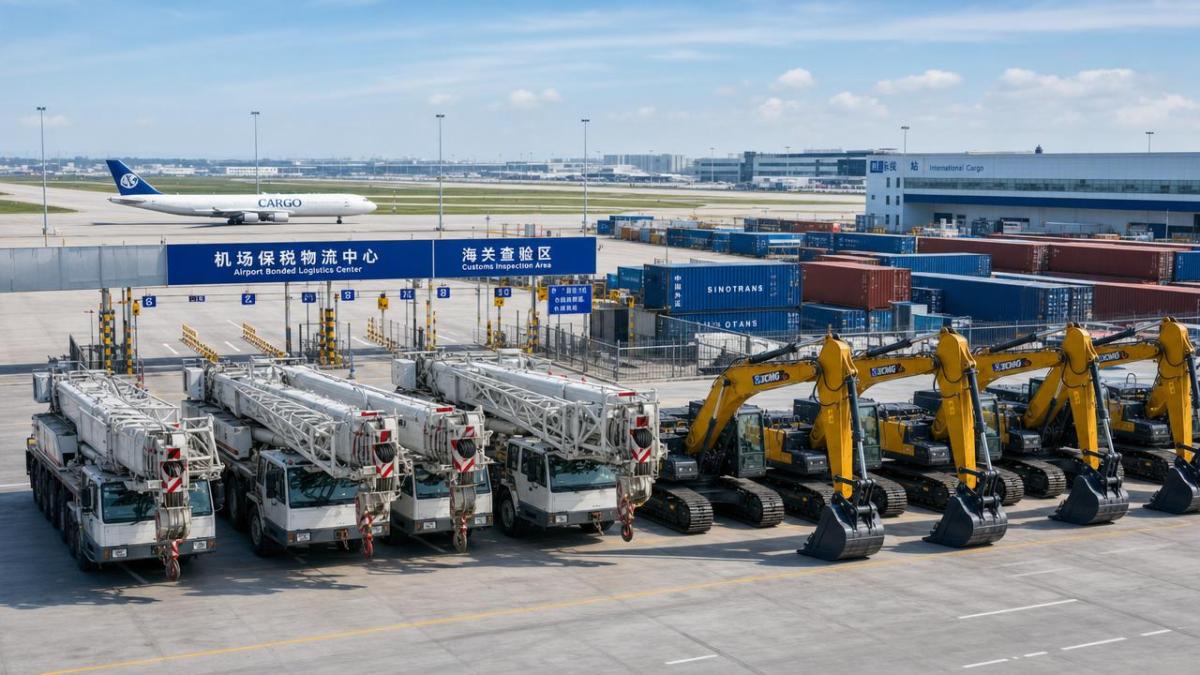
The timing of the move was not specified in the source material, but on June 12, 2026, authorities in Changsha’s airport free trade area and Huanghua Airport Customs announced a new customs model for road-going construction machinery such as truck cranes and large excavators. By combining a “one declaration, multiple vehicles” approach with a bundled supervision mechanism, the initiative has drawn industry attention because it points directly to export delivery speed, logistics cost control, and execution certainty for manufacturers, exporters, and supply chain service providers.

What Has Been Confirmed So Far
According to the information provided, the new clearance model applies to road-category construction machinery including truck cranes and large excavators. The arrangement was jointly announced by the Changsha Airport Free Trade Zone administrative committee and Huanghua Airport Customs.
The confirmed operational change is the adoption of a “one declaration, multiple vehicles” model, supported by what was described as a combined supervision innovation. Based on the official announcement summarized in the input, the overall customs clearance time has been reduced by 50%, while logistics cost per unit has fallen by RMB 300 to RMB 500.
The mechanism has already been used for exports of more than 4,200 units of equipment from Zoomlion and Sunward Intelligent. The provided summary states that this has materially improved delivery certainty.
Why the Change Matters Along the Export Chain
For equipment exporters, delivery management becomes more visible
From an industry perspective, exporters of large road-going machinery may be affected first because customs handling sits close to the final dispatch stage. A shorter clearance window can influence shipment scheduling, customer delivery commitments, and the reliability of outbound execution. What deserves closer attention is whether companies can align internal documentation, dispatch sequencing, and customs preparation with the new model.
For logistics and customs service providers, process coordination becomes the key variable
Supply chain service providers may see the impact in cargo organization, declaration rhythm, and handoff management. Analysis shows that when a new clearance arrangement lowers time and unit cost, the operational benefit depends not only on the rule itself but also on whether freight forwarders, customs brokers, and yard or transport operators can coordinate around it without creating new bottlenecks elsewhere.
For overseas buyers and project-facing channels, certainty may matter more than headline savings
Procurement-side stakeholders and channel partners may be less focused on the absolute cost reduction of RMB 300 to RMB 500 per machine than on whether delivery promises become more dependable. Observably, for heavy equipment exports, predictability can matter in customer communication, installation timing, and project planning, even when the policy change originates in a customs procedure.
What Companies Should Watch Next
Track how the rule is described in follow-up official language
Companies should pay attention to whether future official notices further clarify applicable product categories, filing requirements, or execution conditions. The current information confirms the model and the reported efficiency gains, but businesses still need to distinguish between a policy direction and the detailed operating rules that determine day-to-day usability.
Review document readiness for eligible machinery shipments
For exporters handling truck cranes, large excavators, or similar road-category machinery, practical attention should center on whether internal document flows, product classification materials, and shipment-level records are complete and consistent. If the model depends on smoother multi-vehicle handling under one declaration, document discipline may become a direct factor in capturing the promised time savings.
Reassess delivery communication with customers
Where companies serve overseas buyers with tight delivery windows, this development may justify an update to external communication on lead times and shipment planning. Analysis shows that the value of faster clearance is highest when sales teams, export operations teams, and customers are working from the same assumptions about dispatch timing.
Separate immediate savings from scalable process change
The reported reduction of RMB 300 to RMB 500 per unit is concrete, but companies should also assess whether the larger business effect comes from improved planning stability rather than from direct cost alone. What deserves closer attention is whether the model supports repeatable execution across more shipments, not just isolated cases.
How This News Should Be Read at This Stage
Analysis shows that this is more than a routine customs efficiency update, because the reported effect reaches both cost and delivery certainty in a machinery export context. At the same time, it is more appropriate to understand this as a targeted operational signal rather than a full-sector conclusion. The confirmed data points relate to specific machinery types, a specific trade and customs setting, and already-covered exports from named companies.
Observably, the industry should continue watching whether this model remains concentrated in the current application scope or whether further clarification expands its practical relevance. Without additional verified information, it would be premature to treat the change as a universal shift for all construction machinery exports.
A Practical Reading of the Development
In practical terms, the announcement indicates that customs-side process design can materially affect export execution for large construction machinery. The most reasonable current interpretation is that this is a meaningful operational development with proven use in a defined setting, and one that deserves close monitoring for broader business relevance. It should be viewed neither as a minor procedural footnote nor as a confirmed industry-wide transformation at this stage.
Basis of This Article
This article is based on the user-provided news title, event timing information, and event summary. The specific official source link was not provided in the input, so the underlying announcement and any subsequent implementation details still require ongoing verification.
For this type of industry development, commonly relevant source categories may include official government or customs notices, company disclosures, industry association releases, authoritative media reporting, and other formal regulatory or standards-related documents. Follow-up attention should focus on any later clarification of eligibility scope, operating requirements, and whether additional implementation results are disclosed.
Recommended News
- 00
0000-00
How to compare crushing screening contractors by production capacityCrushing screening contractors compared by real production capacity: assess accepted output, uptime, material handling, quality compliance, and project risk. - 00
0000-00
Impact crusher rotor design and its effect on output sizeImpact crusher rotor design directly affects output size, fines, and wear. Learn how rotor speed, diameter, and blow bars shape better crushing results. - 00
0000-00
How to Evaluate a Hydraulic Breaker Systems Supplier for Uptime, Parts Support, and Total CostHydraulic breaker systems supplier evaluation made practical: learn how to compare uptime, parts support, service response, and total cost before choosing the right partner.
000000-00
{item.title}{item.description}Search News
Industry Portal
Hot Articles
- What to check before choosing an aggregate production line manufacturerChoose an aggregate production line manufacturer with confidence. Explore key checks for capacity, product quality, layout, service, lifecycle cost, and reliable project delivery.
- When does open-pit mining fleet electrification cut haulage costs?Mining Fleet Electrification open pit: learn when electrified haulage lowers cost per tonne through reliable power, stable routes, high utilization and smarter charging.
- How TBM cutterheads should match abrasive rock conditionsTBM Cutterheads for abrasive rock: learn how geology, cutter layout, wear protection, muck flow, and maintenance strategy improve tunnelling reliability.
Popular Tags