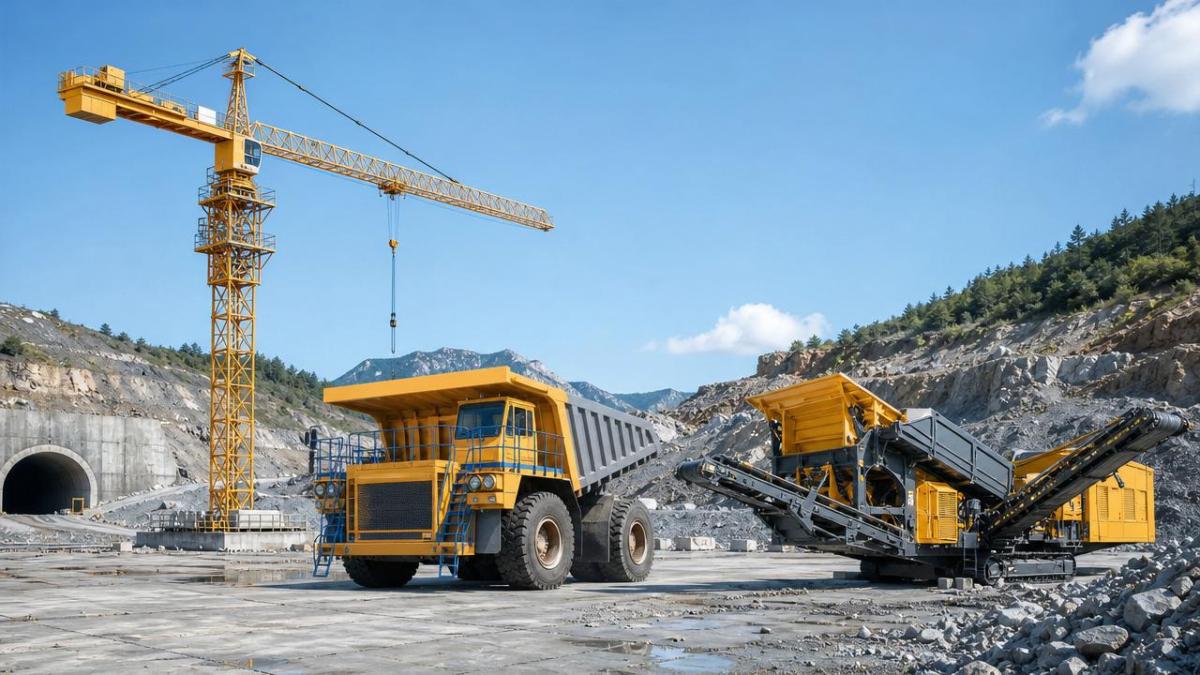
Mega Construction Equipment Selection Mistakes to Avoid
auth.Mr. Gideon CrossTime
May 19, 2026Click Count
Choosing mega construction equipment is a high-stakes decision for procurement teams balancing cost, safety, uptime, and long-term project returns. From tower cranes and TBMs to mining trucks and crushing systems, small selection mistakes can trigger major delays, compliance risks, and rising lifecycle expenses. This guide highlights the most common errors buyers should avoid to secure reliable performance, stronger ROI, and smarter heavy equipment investment outcomes.
For buyers working across mining, tunneling, lifting, aggregate processing, and bulk material production, the wrong equipment decision rarely fails on day one. Problems usually surface after 90 days, 6 months, or the first hard production cycle, when utilization, maintenance load, site compatibility, and spare parts access begin to affect total project economics.
In the world of mega construction equipment, procurement is not just about tonnage, reach, or nameplate power. It is about matching machine capability to geomechanics, duty cycle, safety rules, logistics limits, operator readiness, and life-of-project cost. That is especially true for purchasers evaluating tower cranes, TBMs, mining dump trucks, crushing systems, and mixing plants in large EPC or infrastructure programs.
Why Procurement Errors Become Expensive at Mega Scale

Mega construction equipment operates in environments where even a small mismatch can multiply into major cost exposure. A crane with insufficient wind-load tolerance, a TBM not optimized for abrasive rock, or a mining truck fleet selected without haul-road analysis can each cause downtime measured in weeks rather than hours.
For procurement teams, the risk is amplified by three factors: high capital value, long delivery cycles, and limited room for substitution after mobilization. A large TBM or 300-ton class truck may involve a lead time of 4 to 12 months. Once ordered, design changes are costly, and field retrofits can disrupt commissioning schedules.
The Four Cost Layers Buyers Often Underestimate
- Initial acquisition cost, including base unit, attachments, and transport
- Operating cost per hour or per ton, including fuel or power, wear parts, and labor
- Downtime cost, including production loss, standby crews, and contract penalties
- Exit cost, including relocation, resale value, and parts obsolescence
In many heavy-duty applications, downtime can exceed 3 to 10 times the daily cost of routine maintenance. That is why experienced buyers increasingly compare lifecycle economics over 5 to 10 years instead of focusing only on purchase price.
Typical Procurement Pressures in HIES-Type Projects
HIES-aligned sectors such as ultra-large lifting, deep tunneling, autonomous haulage, and large-scale crushing face unusual technical and capital pressures. Projects may involve abrasive geology, 24/7 utilization, altitude or coastal weather, and strict safety controls. These conditions make technical due diligence a purchasing requirement, not a nice-to-have step.
The table below shows how common buying shortcuts in mega construction equipment selection translate into operational consequences over the first 12 to 24 months.
The pattern is clear: what looks efficient during bidding can become expensive during operations. Strong procurement teams therefore treat technical fit, support depth, and lifecycle predictability as equal to commercial price.
The Most Common Mega Construction Equipment Selection Mistakes
Most selection failures follow repeatable patterns. Buyers can avoid them by asking better questions before RFQ release, factory review, and contract award. The mistakes below are common across cranes, TBMs, mining trucks, crushers, and batching systems.
Mistake 1: Buying for Maximum Capacity Instead of Real Duty Cycle
A frequent procurement error is selecting mega construction equipment by headline capacity alone. For example, a larger crane boom, a bigger truck payload, or a higher crushing throughput may appear safer on paper, but oversizing can increase fuel burn, idle losses, transport complexity, and maintenance burden.
Procurement should compare expected utilization rates, average daily production, peak loading windows, and seasonal downtime. If actual use will remain at 55% to 70% of rated output, the best option may be a more balanced configuration with lower operating cost per effective unit of work.
What to check
- Average and peak duty cycle over a 12-month schedule
- Site loading profile, material density, and travel distance
- Whether capacity gains improve real output or only nominal output
Mistake 2: Ignoring Ground, Rock, and Environmental Conditions
Site conditions are often the single biggest technical variable in mega construction equipment performance. A TBM for mixed face conditions differs materially from one optimized for competent hard rock. A crushing train handling high-silica ore faces different liner and screen wear patterns than one processing softer limestone.
The same principle applies to tower cranes exposed to coastal wind, mining trucks working on 10% gradients, and asphalt plants operating in low-temperature regions. Procurement should request condition-based selection logic, not only generic brochures.
Mistake 3: Underestimating Logistics and Assembly Constraints
Some buyers compare units at machine level but forget route access, heavy-lift requirements, foundation works, and erection windows. This is risky for ultra-large cranes, modular crushing plants, and long TBM assemblies, where transport packaging, on-site assembly space, and installation sequencing can determine actual project feasibility.
A procurement checklist should include transport envelope, maximum single-piece weight, erection equipment needs, utility interface requirements, and assembly duration. In remote projects, mobilization can account for 8% to 15% of total installed cost.
Mistake 4: Treating Compliance as a Final-Step Paper Exercise
For mega construction equipment, safety and compliance cannot be validated after commercial award. Lifting regulations, mining safety frameworks, emissions rules, electrical standards, and operator protection requirements must be reviewed early. This matters especially for cross-border procurement and export-oriented projects.
A unit that meets one jurisdiction’s expectation may require redesign, recertification, or additional guarding in another. Even a delay of 2 to 6 weeks in compliance acceptance can affect critical path activities on major infrastructure work.
How to Evaluate Mega Equipment the Right Way
Better outcomes come from a structured evaluation model. Procurement teams should score technical fit, support resilience, commercial structure, and long-term operating value. This method creates stronger alignment between purchasing, operations, maintenance, and project controls.
A Practical 5-Step Assessment Framework
- Define the operating profile: material, geology, altitude, climate, and shift pattern
- Confirm the performance target: tons per hour, meters per day, lift plan, or cycle time
- Evaluate support: parts stock, field service response, and commissioning capability
- Model lifecycle cost over 3, 5, and 10 years
- Validate compliance, logistics, and operator readiness before final award
This approach helps teams avoid a narrow price-led decision. In many cases, a machine with a 6% higher initial price can deliver a 12% to 20% lower total ownership cost if uptime, energy use, tire life, or wear-part consumption is materially better.
Key Procurement Criteria by Equipment Type
Because mega construction equipment covers multiple machine classes, buyers should adjust their evaluation points by application. The table below summarizes common decision factors across the core HIES domains.
The best sourcing decision is usually the one with the fewest unresolved technical assumptions. Where geology, altitude, abrasivity, or automation level is uncertain, buyers should request scenario-based performance ranges rather than single-point claims.
Don’t Skip Service and Digital Support Readiness
For high-value equipment, parts and digital diagnostics matter almost as much as steel and horsepower. Buyers should ask about critical spare stock, field engineer dispatch windows, remote monitoring availability, and training hours included in the package. A common baseline is 24 to 72 hours for field response and 12 to 40 hours of operator and maintenance training at startup.
This becomes even more important with electrified fleets, autonomous haulage systems, and sensor-rich crushing or mixing plants. Procurement contracts should specify software support boundaries, update responsibility, and data access rights from day one.
Questions Procurement Teams Should Ask Before Signing
Strong buyers reduce risk by forcing clarity early. The right vendor questions help expose hidden assumptions in performance, delivery, service, and installation. They also make cross-functional approval easier for engineering, safety, operations, and finance teams.
Critical Questions for RFQ and Final Negotiation
- What operating conditions were assumed in the quoted performance numbers?
- Which wear parts are expected to be replaced in the first 2,000 operating hours?
- What exclusions apply to commissioning, training, and local compliance adaptation?
- What is the realistic spare parts lead time for top 20 critical items?
- How will output, availability, and consumption be measured after handover?
Useful internal checkpoints
Before finalizing a mega construction equipment order, procurement should hold at least 3 internal reviews: technical validation, commercial validation, and risk validation. This process usually takes 2 to 4 weeks but can prevent months of avoidable disruption later.
A disciplined buying process is especially valuable when equipment supports strategic infrastructure, high-output mining, or multi-country EPC schedules. In these environments, the right machine is not just a capital asset. It is a production system, a safety system, and a margin protection tool at the same time.
Final Buying Guidance for Smarter Heavy Equipment Investment
Avoiding selection mistakes in mega construction equipment starts with one principle: buy for the job reality, not the brochure headline. Procurement teams that align machine choice with geology, duty cycle, logistics, compliance, service depth, and lifecycle cost consistently reduce risk and improve asset returns.
For organizations sourcing tower cranes, TBMs, heavy mining trucks, crushing systems, or large material plants, intelligence-led evaluation creates a measurable advantage. It supports better uptime, fewer contract surprises, and stronger cost control across the full project horizon.
If you are reviewing mega construction equipment for an upcoming project, now is the right time to validate your shortlist, compare lifecycle scenarios, and test supplier assumptions in detail. Contact us to discuss your application, get a tailored procurement framework, or explore more heavy infrastructure equipment solutions built around real operating conditions.
Recommended News
- 00
0000-00
What to check before choosing an aggregate production line manufacturerChoose an aggregate production line manufacturer with confidence. Explore key checks for capacity, product quality, layout, service, lifecycle cost, and reliable project delivery. - 00
0000-00
What drives the price of a luffing jib crane for an EPC project?Luffing jib crane price depends on lift capacity, radius, hook height, wind, foundations, logistics, and safety systems. Learn how EPC teams compare quotes and control total project cost. - 00
0000-00
What to verify before choosing a mineral processing equipment manufacturerMineral processing equipment manufacturer selection guide: verify process guarantees, duty-cycle reliability, engineering interfaces, service support, and lifecycle cost.
000000-00
{item.title}{item.description}Search News
Industry Portal
Hot Articles
- What to check before choosing an aggregate production line manufacturerChoose an aggregate production line manufacturer with confidence. Explore key checks for capacity, product quality, layout, service, lifecycle cost, and reliable project delivery.
- When does open-pit mining fleet electrification cut haulage costs?Mining Fleet Electrification open pit: learn when electrified haulage lowers cost per tonne through reliable power, stable routes, high utilization and smarter charging.
- How TBM cutterheads should match abrasive rock conditionsTBM Cutterheads for abrasive rock: learn how geology, cutter layout, wear protection, muck flow, and maintenance strategy improve tunnelling reliability.
Popular Tags