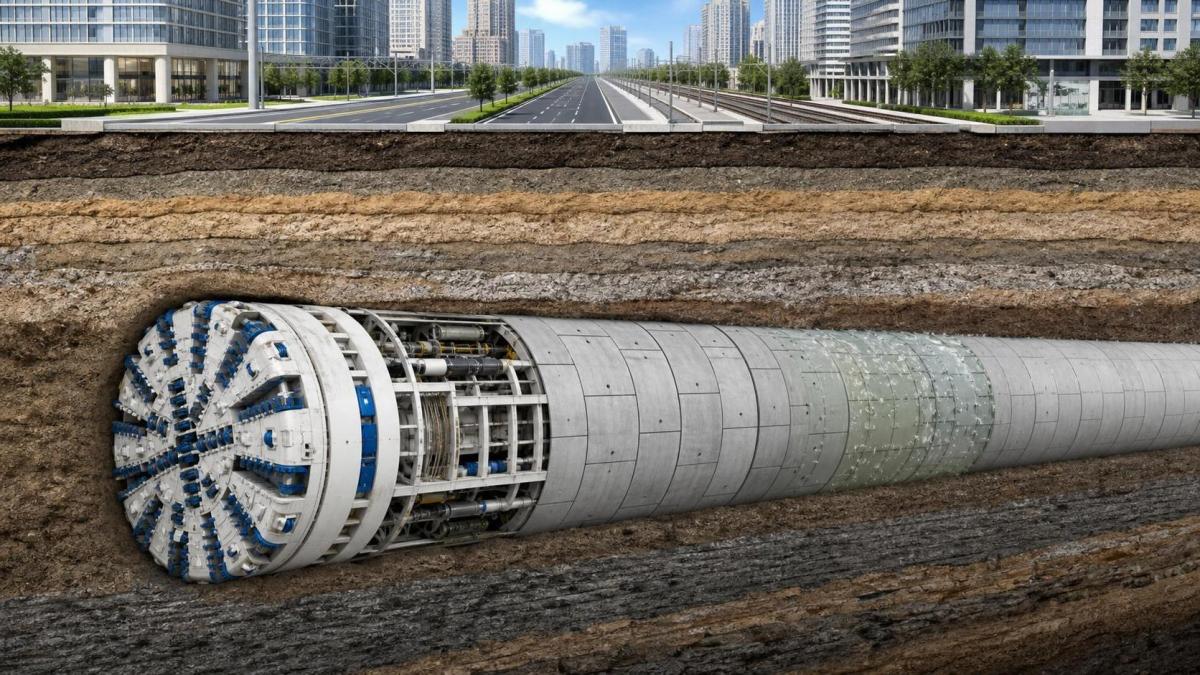
When tunnel construction technology reduces ground settlement risk
auth.Prof. Heinrich AldenTime
Aug 23, 2026Click Count
When tunnel construction technology reduces ground settlement risk
For project managers, settlement is rarely just a geotechnical issue. It quickly becomes a schedule issue, a claims issue, a public relations issue, and sometimes a safety issue. In dense urban corridors or rail interfaces, a few millimeters of unexpected movement can trigger instrument alarms, traffic restrictions, utility inspections, redesign discussions, and stakeholder pressure. That is why tunnel construction technology matters most when it helps teams control what happens in the ground before movement turns into disruption.
The practical question is not whether settlement can be eliminated. It usually cannot. The real question is whether the chosen excavation method, support system, monitoring architecture, and construction control loop can keep settlement within acceptable project limits while maintaining production. Good tunnel construction technology does exactly that: it reduces uncertainty, shortens reaction time, and makes ground behavior more predictable.
This is also where a technical intelligence platform such as HIES becomes useful. In heavy infrastructure, machine capability cannot be separated from geology, logistics, cutter wear, maintenance access, power systems, compliance, or lifecycle cost. HIES follows that wider picture across tunneling systems, TBM cutterheads, disc cutters, material processing equipment, lifting systems, and construction technologies, which is often how project teams actually evaluate risk in the field.
Why settlement happens even on well-planned tunnel jobs
Ground settlement above a tunnel typically comes from volume loss. That sounds simple, but the causes vary. Over-excavation, inadequate face support, delayed segment erection, poor annular grouting, groundwater drawdown, weak transitions between soil layers, and local void migration can all contribute. In conventional methods, unstable headings and insufficient pre-support may do the same. Even when design assumptions are sound, field variability is often the problem. Mixed-face conditions, obstructions, boulders, abrasive zones, old foundations, and undocumented utilities can shift risk very quickly.
For project leaders, the important point is that settlement usually reflects a chain of small control losses rather than one dramatic failure. That is why modern tunneling systems focus so heavily on maintaining face pressure, steering accuracy, excavation balance, and immediate feedback from instrumentation.
The technology choices that make the biggest difference
Not every project needs the same answer. A shallow metro under historic buildings is not managed the same way as a hard rock rail tunnel with limited surface sensitivity. Still, several technology choices repeatedly influence settlement performance.
1. Excavation method matched to ground response
The first control point is method selection. Earth Pressure Balance TBMs are often preferred where fine-grained soils need stable face support using conditioned spoil. Slurry TBMs are commonly considered where high groundwater pressure, permeable soils, or unstable granular formations make slurry support more reliable. In rock, the issue may shift from face pressure to overbreak control, blast vibration, or support timing. Choosing the wrong method does not just affect advance rate; it changes the settlement mechanism itself.
This sounds obvious, yet method selection is sometimes compressed into procurement logic or headline CAPEX comparisons. That is risky. A machine that appears efficient on paper can still create downstream cost if it struggles to maintain balance in variable ground or if its tooling and cutterhead configuration are mismatched to the actual formation.
2. Cutterhead and tooling configuration
Settlement control is not only about the shield or support pressure. Cutterhead opening ratio, tool arrangement, wear resistance, and muck flow behavior affect how evenly material is excavated and discharged. In abrasive or mixed formations, cutter wear can gradually reduce cutting efficiency and destabilize excavation behavior before it becomes obvious at surface level. HIES often covers this connection in its analysis of TBM cutterheads and disc cutters, because wear is not just a maintenance topic; it can become a ground control topic.
Project teams should pay attention to how tooling strategy will be maintained over time. A well-configured cutterhead at launch does not stay well-configured if inspection intervals, spare availability, or intervention planning are weak.

3. Real-time monitoring linked to actual decisions
Instrumentation only helps if someone can act on it fast enough. Surface settlement markers, extensometers, inclinometers, piezometers, building monitoring points, and TBM operational data all have value, but not when they sit in separate reporting silos. The stronger projects create a decision loop between field data and machine parameters: face pressure, advance rate, screw conveyor speed, slurry circuit behavior, grouting pressure, articulation, and steering corrections.
A common mistake is treating monitoring as a compliance package rather than a live operational tool. Once that happens, warning thresholds become paperwork instead of triggers for immediate excavation adjustments.
4. Backfill and annular grouting quality
On mechanized tunneling jobs, the gap between the excavated ground and the installed lining is one of the most sensitive settlement drivers. If annular voids are not filled consistently and at the right pressure, delayed ground relaxation can appear even when face stability looked acceptable during excavation. Grout mix behavior, injection control, setting time, and actual fill verification matter more than many non-specialists expect.
This is one reason cross-disciplinary review helps. Material handling, batching precision, and process consistency are not separate from tunnel performance. HIES covers adjacent equipment domains such as concrete batching and high-precision material systems because infrastructure outcomes often depend on these supporting processes, not just the headline machine underground.
How project managers should read settlement risk before excavation starts
Preconstruction reviews often spend a lot of time on alignment, contract packaging, and access constraints. Those are necessary, but if settlement is a priority, a few questions deserve sharper attention:
- How variable is the geology across the drive, especially at interfaces between soil types or weathered rock zones?
- What adjacent assets are movement-sensitive: heritage structures, operating rail, buried utilities, shafts, or piled foundations?
- How will allowable movement criteria be defined, verified, and escalated?
- Can the selected tunneling system maintain stable excavation parameters in both expected and transition conditions?
- What is the intervention plan if tooling wear, groundwater change, or unexpected voiding occurs?
These questions are not academic. They shape procurement specifications, staffing, spare parts strategy, shift procedures, and contingency budgeting. If the project cannot answer them clearly, settlement risk usually remains under-described, even if the design package looks complete.
Where technology helps, and where it does not
Advanced tunnel construction technology can improve control, but it does not override poor inputs. A highly automated TBM will not compensate for incomplete ground investigation. Dense sensor networks will not solve a weak response protocol. Digital dashboards will not reduce settlement if shift teams are not aligned on which parameters they can change and when.
The strongest use of technology is usually in reducing delay between observation and correction. For example, if surface movement trends correlate with face instability or inconsistent grouting behavior, teams need a system that makes those relationships visible quickly. That may involve integrated machine data, geotechnical dashboards, and disciplined shift reporting rather than any single breakthrough device.
This is also why experienced owners and EPC teams tend to look beyond brochure features. They ask how a machine behaves in mixed ground, how often tools can be inspected, how spare logistics work, how data is shared, and how operators are supported during difficult drives. HIES addresses these kinds of questions across infrastructure equipment because commercial evaluation and technical risk are inseparable in real projects.
Common misreads that lead to avoidable settlement problems
One misread is focusing too heavily on average geology. Settlement incidents often occur in transitions, not averages. Another is assuming that if daily advance rates are on target, ground behavior must be acceptable. Production can look healthy while the margin of control narrows underneath.
There is also a habit of separating “tunneling issues” from “supporting plant issues.” In practice, slurry treatment reliability, grout consistency, segment logistics, lifting coordination, and maintenance downtime all influence how consistently excavation is managed. Heavy infrastructure projects are systems, not isolated machines.
Finally, some teams treat settlement limits as a fixed number rather than a response framework. The number matters, but so do trigger levels, inspection workflows, authority lines, and predefined corrective actions. Without those, alarm thresholds arrive late or create confusion instead of control.
A more useful way to evaluate tunnel technology options
If settlement control is central to project success, technology review should combine geotechnical fit, operational resilience, and commercial realism. That means looking at the excavation method, pressure control capability, cutterhead adaptability, wear management, grouting system performance, monitoring integration, crew competency requirements, and maintenance support together.
It also means being cautious with simplified comparisons. A lower acquisition cost or faster delivery window may be attractive, but if the system is harder to stabilize in local ground conditions, the project may pay later in lost time, additional mitigation, or third-party protection measures. For project managers, that trade-off is often more important than headline machine specifications.
Where information is fragmented, independent technical intelligence becomes valuable. HIES is useful in that sense because it sits across tunneling, material systems, lifting equipment, wear components, automation, and lifecycle economics. That broader view helps teams ask better questions before tender, before launch, and before problems surface above ground.
What to confirm before committing to a solution
Before locking in a tunneling approach, it is worth confirming a few basics in project-specific detail: the expected settlement sensitivity of adjacent assets, the likely variability of the face, the support and grouting philosophy, the instrumentation-to-action workflow, and the practical plan for tooling wear and interventions. Those points usually decide whether tunnel construction technology becomes a risk reducer or just an expensive layer of complexity.
Ground settlement is not managed by one machine feature. It is managed by a chain of choices that starts with geology and ends with disciplined execution. When the technology is properly matched to the ground and the control loop is tight, tunnel projects tend to move with fewer surprises, fewer emergency responses, and more confidence from everyone watching what happens at the surface.
Recommended News
- 00
0000-00
How TBM cutterheads should match abrasive rock conditionsTBM Cutterheads for abrasive rock: learn how geology, cutter layout, wear protection, muck flow, and maintenance strategy improve tunnelling reliability. - 00
0000-00
How rock mechanics testing helps predict excavation risksRock mechanics testing helps predict excavation risks by assessing strength, fractures, groundwater, and deformation for safer, smarter project decisions. - 00
0000-00
When should a mining project hire geomechanics consultants?Geomechanics consultants help mining projects manage slope, ground support, water, and infrastructure risks early—discover the key hiring triggers.
000000-00
{item.title}{item.description}Search News
Industry Portal
Hot Articles
- What to check before choosing an aggregate production line manufacturerChoose an aggregate production line manufacturer with confidence. Explore key checks for capacity, product quality, layout, service, lifecycle cost, and reliable project delivery.
- When does open-pit mining fleet electrification cut haulage costs?Mining Fleet Electrification open pit: learn when electrified haulage lowers cost per tonne through reliable power, stable routes, high utilization and smarter charging.
- How TBM cutterheads should match abrasive rock conditionsTBM Cutterheads for abrasive rock: learn how geology, cutter layout, wear protection, muck flow, and maintenance strategy improve tunnelling reliability.
Popular Tags