China Tightens AHS Export Compliance
auth.Heavy Haulage StrategistTime
Aug 12, 2026Click Count
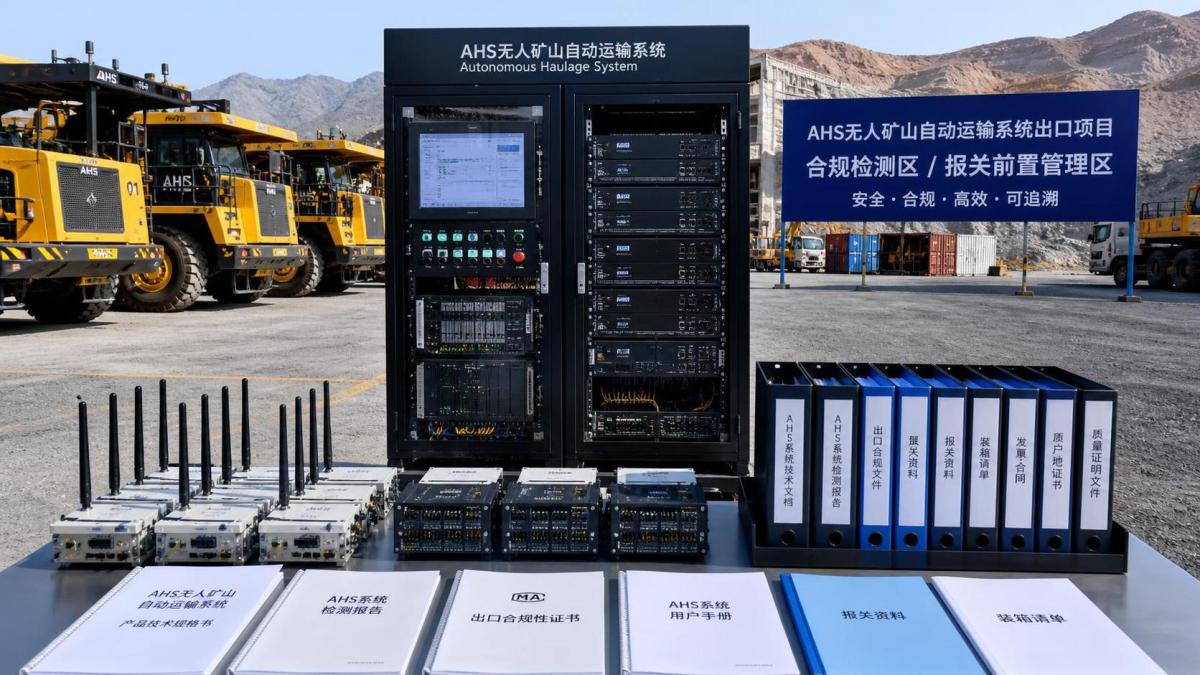
On 2026-08-12, Chinese customs and the Ministry of Industry and Information Technology issued a notice on export compliance for intelligent mining equipment, adding a pre-export type test and customs filing requirement for autonomous haulage systems (AHS) and key subsystems shipped to 32 countries, including the EU, Australia, Chile and Canada. From an industry perspective, the change is most relevant to AHS manufacturers, system integrators and overseas EPC contractors, because it can affect customs clearance timing and delivery sequencing.
What the new rule requires
The notice, released on 2026-08-11 under No. 88 of 2026, states that from 2026-08-12 onward, all exports of autonomous mining transport systems (AHS) and their core subsystems must complete a type test report issued by a national testing institution before export, and must also finish customs filing. The covered subsystems mentioned in the notice include dispatch platforms, in-vehicle V2X communication modules and functional safety controllers. The requirement applies to exports to 32 countries, including the EU, Australia, Chile and Canada.

Where the impact will be felt first
AHS manufacturers will need to align product release and shipment timing
For complete-system manufacturers, the main impact is not only in documentation, but in the export sequence itself. If the relevant type test and filing steps are not completed in advance, shipment readiness may no longer translate directly into customs clearance readiness. That means production, testing and export scheduling will need to be linked more tightly than before.
System integrators will need clearer subsystem traceability
Because the notice explicitly names core subsystems, integrators may need to verify which components fall within the scope of the filing requirement. From an operational perspective, this makes configuration control, technical records and interface documentation more important in the export process.
Overseas EPC contractors may face tighter delivery coordination
For overseas EPC projects, the rule can affect delivery milestones, import handover and site-side installation planning. Even when the project scope is unchanged, customs procedures on the export side may now introduce an additional step that needs to be built into contract execution and logistics coordination.
What companies should pay attention to now
Check whether the product falls within the named scope
Companies should first verify whether their export items are AHS systems or the listed core subsystems. The notice is specific in what it covers, so scope confirmation is the starting point for compliance review.
Prepare testing and filing materials before shipment planning
The practical issue is timing. Since the type test report must be issued before export and customs filing must also be completed, companies need to factor these steps into sales commitments, production completion and booking plans, rather than treating them as post-production paperwork.
Review destination-country routes and project schedules
Because the requirement applies to exports to 32 countries, export teams should map current orders and near-term bids against destination markets. What deserves closer attention is whether existing delivery plans already assume clearance timelines that will now be too tight.
Keep customer communication aligned with the new compliance step
For manufacturers and EPC contractors, the immediate commercial issue is not just compliance work internally, but explaining possible timing changes to downstream customers. Contract milestones, delivery windows and handover expectations may all need to be checked against the new filing sequence.
How this should be read
Analysis shows this is more than a routine paperwork update. It signals that export compliance for intelligent mining equipment is being handled with a clearer pre-export control framework, at least for the covered categories and destinations. At the same time, it is more appropriate to understand this as an implementation change that still needs to be tracked closely, rather than a broader conclusion about the entire mining equipment export market.
For the sector, the key point is operational: the export path for AHS-related products now includes a defined testing and filing gate before shipment. That makes compliance planning part of delivery planning, not a separate afterthought.
What this means in practice
This notice should currently be read as a concrete compliance requirement with immediate operational impact for relevant exporters, rather than as a general market forecast. The most important question for companies is whether they have already built testing, filing and customer communication into the export workflow. The rule’s longer-term significance will depend on how it is applied in practice and whether similar requirements are extended or clarified later.
Source note
This article was generated based on the user-provided headline, event date and event summary. The type of sources typically relevant to this kind of update include official notices, customs releases, ministry announcements, company announcements, industry association information, and authoritative media reports. A specific official source link was not provided in the input, so the original notice should continue to be verified against official channels.
Recommended News
- 00
0000-00
China Tightens AHS Export ComplianceChina tightens AHS export compliance with new type testing and customs filing rules. Learn how autonomous haulage system exporters can avoid delays, protect delivery schedules, and stay compliant. - 00
0000-00
EU Requires EN 50126-3 for AHS Mining Trucks from Oct 2026EN 50126-3 becomes essential for AHS mining trucks entering the EU from Oct 2026. Learn compliance impacts, CE documentation risks, and how suppliers can prepare faster. - 00
0000-00
Australia Sets AHS Safety Certification RuleAustralia Sets AHS Safety Certification Rule: Learn how AS 61508:2026 Ed.3 and SIL2 requirements will impact AHS exports, approvals, delivery timelines, and market access in Australia.
000000-00
{item.title}{item.description}Search News
Industry Portal
Hot Articles
- What to check before choosing an aggregate production line manufacturerChoose an aggregate production line manufacturer with confidence. Explore key checks for capacity, product quality, layout, service, lifecycle cost, and reliable project delivery.
- When does open-pit mining fleet electrification cut haulage costs?Mining Fleet Electrification open pit: learn when electrified haulage lowers cost per tonne through reliable power, stable routes, high utilization and smarter charging.
- How TBM cutterheads should match abrasive rock conditionsTBM Cutterheads for abrasive rock: learn how geology, cutter layout, wear protection, muck flow, and maintenance strategy improve tunnelling reliability.
Popular Tags