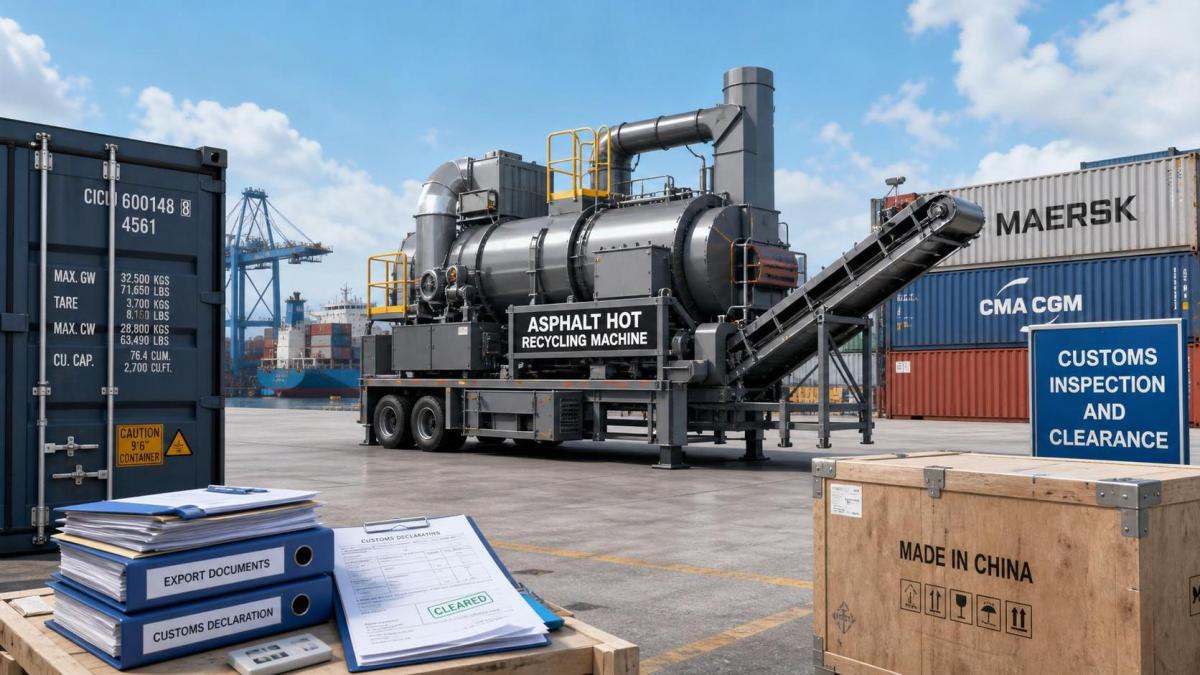
China Tightens Export Checks on Asphalt Recycling Equipment
auth.Paving Materials FellowTime
Jul 08, 2026Click Count
On July 15, 2026, a new customs compliance requirement began affecting exports of asphalt hot recycling equipment from China to the EU, the UK, South Korea, and Mexico. The change is worth close attention from equipment manufacturers, exporters, customs teams, and project delivery functions because it links shipment clearance directly to a producer-signed REACH Annex XVII benzo[a]pyrene compliance statement and local customs verification, with non-compliant cargo facing suspension of clearance or return.

What the new customs notice requires
According to the information provided, the General Administration of Customs of China issued the Notice on Strengthening Environmental Compliance Management for Exported Road Engineering Equipment on July 7, 2026, under reference number 88 of 2026. From July 15, 2026, all asphalt hot recycling equipment exported to the EU, the UK, South Korea, and Mexico, including continuous and batch hot recycling modules, must be accompanied by a compliance declaration on benzo[a]pyrene under REACH Annex XVII signed by the manufacturer.
The same information states that the declaration will be subject to verification by the competent local customs authority. If the required declaration is not provided, the goods may be suspended from customs clearance or returned.
Where the immediate pressure is likely to appear
Export transactions face a documentation gate
From an industry perspective, direct exporters are likely to feel the first impact at the shipment preparation stage. The reason is straightforward: the requirement is tied to customs release, so the issue is not only product compliance in principle but also whether the required declaration is present, signed by the producer, and ready for inspection at the time of export.
What deserves closer attention is the operational link between sales, documentation, and shipping schedules. For exporters serving the specified markets, a missing declaration can turn into a delivery disruption rather than a later-stage administrative issue.
Manufacturers move to the center of compliance responsibility
Analysis shows that equipment manufacturers, including those supplying continuous or batch hot recycling modules, now sit at the core of the documentation chain because the declaration must be signed by the producer. That increases the practical importance of internal review, sign-off authority, and consistency between exported product scope and the declaration attached to each shipment.
The main business impact is likely to fall on product classification, export document preparation, and coordination with overseas orders. Manufacturers that previously relied on downstream trading parties to manage export paperwork may need closer direct involvement.
Supply chain and customs service functions may see tighter coordination demands
Observably, supply chain service providers and customs-facing teams may be affected through timing and verification risk. Because local customs verification is explicitly mentioned, service providers involved in booking, declaration, and shipment release will need clearer document readiness checks before cargo is moved into export clearance.
The practical concern is less about broad market interpretation and more about whether each shipment file is complete for the named destinations. For service teams, the key change is likely to be earlier coordination with manufacturers and exporters on document completeness.
What companies should watch now
Confirm whether shipped products fall within the covered scope
Companies should first verify whether the products they are exporting fall within the scope described in the notice, namely asphalt hot recycling equipment, including continuous and batch hot recycling modules, when the destination is the EU, the UK, South Korea, or Mexico. In practice, this is a product-and-destination check before cargo moves into the export process.
Review declaration ownership and signing process
Because the declaration must be signed by the manufacturer, businesses should focus on who is authorized to issue it, how it is reviewed internally, and how it is matched to the shipment documents. The central issue here is not a general compliance posture but whether the required declaration can be produced in a form acceptable for customs verification.
Align delivery planning with customs verification risk
Analysis shows that the stated consequence of missing documentation, suspension of clearance or return of goods, makes delivery planning a near-term concern. Companies with active or near-term shipments to the named markets should pay attention to lead times, file completeness, and communication between export sales, logistics, and customs support teams.
Keep watching for any further official clarification
What deserves closer attention is the difference between the core rule already stated and any later clarification on implementation details. Businesses should continue monitoring official wording and local execution practice, especially where shipment preparation, declaration format, or customs verification steps may require more detailed interpretation.
How this measure is best understood at this stage
Observably, this is more than a routine paperwork adjustment because the notice ties environmental compliance documentation directly to export clearance for specific products and destinations. At the same time, based on the information provided, it would be too early to treat it as a broad market outcome or to infer wider regulatory expansion beyond the listed equipment and destination markets.
It is more appropriate to understand this as a concrete short-term compliance change with possible longer-term signaling value. The short-term element is clear: shipments without the required producer-signed declaration may not clear customs. The longer-term element remains something to watch, particularly in how strictly the rule is implemented and whether similar documentation expectations appear in adjacent export equipment categories.
Why the industry should read this carefully
The immediate significance of this update lies in execution risk rather than headline value. For companies involved in manufacturing, exporting, documenting, or shipping asphalt hot recycling equipment to the specified markets, the requirement creates a direct checkpoint that can affect dispatch and delivery. The industry should therefore read the measure as an operational compliance issue already in force from July 15, 2026, while keeping a measured view on broader implications until further official developments are available.
Basis of this article and what still needs verification
This article is based on the user-provided news title, event date, and event summary. The analysis has been limited to that provided information and does not rely on additional unverified data, company statements, market figures, or external interpretations.
For this type of development, commonly relevant source categories may include official notices, company disclosures, industry association updates, authoritative media reporting, and standards-related documents. A specific official source link was not provided in the input, so further verification remains necessary. Continued attention should focus on any follow-up official clarification, implementation details in customs practice, and any subsequent wording that may refine product scope or document handling requirements.
Recommended News
- 00
0000-00
EU Tightens RAP Lead Limit to 5 ppm Under REACHEU Tightens RAP Lead Limit to 5 ppm Under REACH: learn how the 2026 rule change impacts asphalt hot recycling equipment, EU compliance, testing documents, and supply chain readiness. - 00
0000-00
EU Tightens RAP Lead Limit to 5 ppm Under REACHEU Tightens RAP Lead Limit to 5 ppm Under REACH: learn how the new EU rule affects RAP sourcing, compliance declarations, and export readiness for hot asphalt recycling equipment suppliers. - 00
0000-00
China Tightens Export Checks on Asphalt Recycling EquipmentChina tightens export checks on asphalt recycling equipment: learn how the new REACH Annex XVII compliance rule may delay customs clearance and what exporters must do now.
000000-00
{item.title}{item.description}Search News
Industry Portal
Hot Articles
- What to check before choosing an aggregate production line manufacturerChoose an aggregate production line manufacturer with confidence. Explore key checks for capacity, product quality, layout, service, lifecycle cost, and reliable project delivery.
- When does open-pit mining fleet electrification cut haulage costs?Mining Fleet Electrification open pit: learn when electrified haulage lowers cost per tonne through reliable power, stable routes, high utilization and smarter charging.
- How TBM cutterheads should match abrasive rock conditionsTBM Cutterheads for abrasive rock: learn how geology, cutter layout, wear protection, muck flow, and maintenance strategy improve tunnelling reliability.
Popular Tags