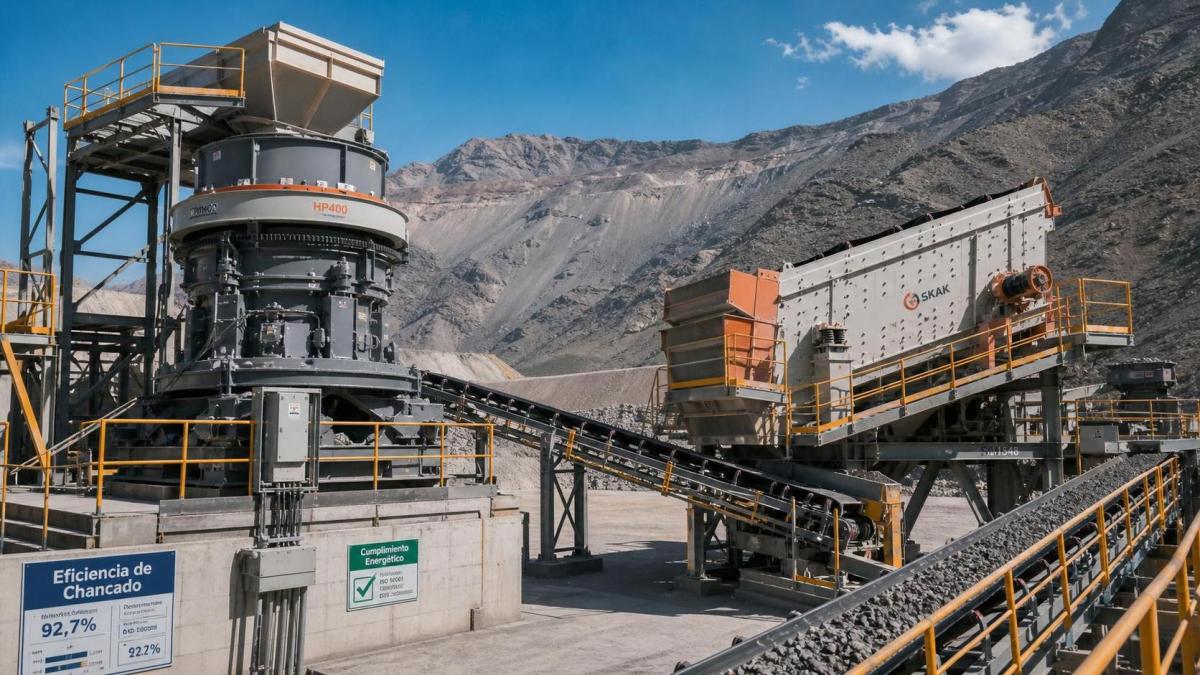
Codelco Delays Crusher Tender, Adds 82% Screen Efficiency Rule
auth.Rock Comminution ExpertTime
Jul 01, 2026Click Count
On June 30, 2026, Chile’s state-owned copper company Codelco said it would move the launch of its large-scale mining crushing system tender for the second half of 2026 from July to September. More notably for equipment suppliers and bidding teams, the technical specification now makes unit energy-based processing efficiency for high-frequency vibrating screens a mandatory evaluation item, with a threshold of at least 82%. This matters not only for crusher and screening equipment manufacturers, but also for procurement, technical compliance, testing, and project delivery teams that support mining tenders.

What Codelco Confirmed on June 30
According to the information provided, Codelco announced on June 30, 2026 that the tender for large mining crushing systems originally scheduled to start in July would be postponed to September 2026. In the updated technical specification, high-frequency vibrating screens are, for the first time, subject to a compulsory bid evaluation requirement based on unit energy consumption processing efficiency, measured in t/kWh, with a minimum requirement of 82%.
The same information also states that suppliers can no longer rely only on meeting basic size and capacity parameters. Third-party energy efficiency test reports and on-site validation data are required. If these materials are not provided, the bid will be automatically disqualified.
Where the Immediate Pressure Falls
Equipment makers face a higher proof threshold
From an industry perspective, manufacturers of hydraulic cone crushers and related screening equipment may be affected because the tender timeline has changed while the technical bar has also become more specific. The impact is not limited to equipment configuration. It extends to how performance is documented, how technical files are prepared, and whether energy-efficiency claims can be evidenced in a form acceptable to the buyer.
Bidding and compliance teams must treat documentation as a core issue
For bidding units and compliance staff, the key change is that technical eligibility now depends on evidence, not only specification matching. What deserves closer attention is the risk of procedural disqualification: if a supplier does not submit the required third-party testing materials and field validation data, the issue is not weaker competitiveness but automatic rejection.
Testing and on-site validation become part of the commercial path
Service providers involved in testing, validation, and bid support may also see a more direct role in tender preparation. Analysis shows that once energy-efficiency performance is written into mandatory evaluation criteria, the business process expands beyond equipment supply into test coordination, data organization, and proof-of-performance readiness.
Chinese suppliers may need to revise market-entry assumptions
The provided information specifically indicates that Chinese suppliers’ bidding strategies will be significantly affected. Observably, the change raises the threshold for suppliers that previously focused on satisfying baseline dimensional and throughput requirements. The practical issue is whether existing product dossiers and field records are already structured for this kind of evaluation.
What Companies Should Watch Before September
Track whether the formal wording changes again
Companies preparing for this tender should closely follow any further official wording around the September schedule and the application of the 82% requirement. Analysis shows that even when the direction is clear, details in tender language can shape how evidence is judged in practice.
Review whether current data is usable for bid submission
Suppliers should examine whether their existing energy-efficiency materials meet the stated standard of third-party testing and on-site validation. The core issue is not simply having performance data, but having documentation that aligns with the buyer’s mandatory review framework.
Separate technical capability from submission readiness
What deserves closer attention is the gap between product capability and bid admissibility. A supplier may believe its high-frequency vibrating screen can meet the requirement, yet still fail at the tender stage if its reports, validation records, or supporting files are incomplete or not presented in the required form.
Prepare coordination across technical, sales, and delivery teams
Because the tender has been delayed rather than canceled, the additional time may need to be used for internal coordination. For companies targeting this opportunity, the practical focus is likely to be on aligning engineering, documentation, customer communication, and submission planning around the revised requirement.
Why This Looks Bigger Than a Schedule Adjustment
Analysis shows that this update should not be read only as a shift from July to September. The more meaningful signal is that a mining buyer has added a quantified energy-efficiency indicator for high-frequency vibrating screens as a compulsory bid criterion. That changes the center of competition from nominal capacity compliance toward verifiable operating efficiency.
It is more appropriate to understand this as a concrete procurement signal rather than a fully settled market outcome. The confirmed fact is the revised tender timing and the new mandatory metric. What remains to be observed is how strictly the requirement is applied in practice and whether similar evaluation logic appears in other procurement settings.
How to Read the Current Signal
At this stage, the industry significance lies in two linked points: the tender window has moved, and the qualification logic has become more evidence-driven. For suppliers and service partners, this is less a broad market conclusion than a near-term operational signal. The current update is best understood as an actionable procurement change with possible longer-term implications, but one that still requires continued observation as the tender process moves toward September.
Basis of This Article
This article is based on the user-provided news title, event date, and event summary. For developments of this kind, relevant source categories would usually include official company announcements, procurement notices, industry association information, authoritative media reporting, and technical specification or standards-related documents. A specific official source link was not provided in the input, so the exact wording and any later revisions still need ongoing verification. Continued attention should be paid to subsequent official tender language, technical clarification documents, and any further explanation of testing or on-site validation requirements.
Recommended News
- 00
0000-00
High-Frequency Screening Technology: How to Improve Efficiency in Fine Material SeparationHigh-frequency screening technology efficiency explained: discover how to boost fine material separation, improve product quality, cut recirculation, and lower operating costs. - 00
0000-00
EU CE Rule Takes Effect for EMC Limits on High-Frequency ScreensEU CE rule update: high-frequency screens sold to the EU from Oct 1, 2026 must meet EN 61000-6-4:2026 EMC limits. See impacts on testing, certification, and delivery planning. - 00
0000-00
High-Frequency Vibrating Screens South Africa: What Affects ThroughputHigh-frequency vibrating screens South Africa: discover what really affects throughput, from ore, moisture, and aperture choice to feed stability and maintenance for better plant results.
000000-00
{item.title}{item.description}Search News
Industry Portal
Hot Articles
- What to check before choosing an aggregate production line manufacturerChoose an aggregate production line manufacturer with confidence. Explore key checks for capacity, product quality, layout, service, lifecycle cost, and reliable project delivery.
- When does open-pit mining fleet electrification cut haulage costs?Mining Fleet Electrification open pit: learn when electrified haulage lowers cost per tonne through reliable power, stable routes, high utilization and smarter charging.
- How TBM cutterheads should match abrasive rock conditionsTBM Cutterheads for abrasive rock: learn how geology, cutter layout, wear protection, muck flow, and maintenance strategy improve tunnelling reliability.
Popular Tags