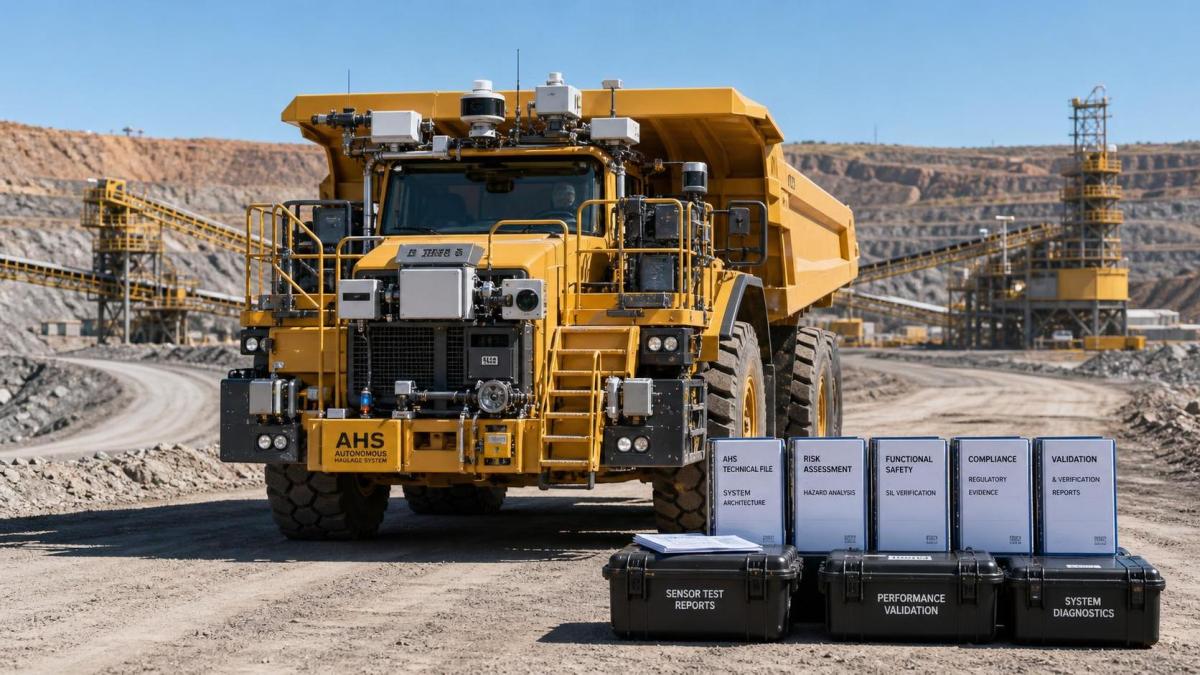
Australia Tightens AHS Truck Import Rules
auth.Heavy Haulage StrategistTime
Jul 31, 2026Click Count
Australia’s Department of Industry and Science issued a technical notice on July 30, 2026 that changes the compliance path for imported articulated dump trucks used in mining when Autonomous Haulage System (AHS) functions are central to the product. From an industry perspective, this is worth close attention because it affects market access, documentation, third-party assessment, and delivery timing for manufacturers, system integrators, importers, and mine-side buyers involved in AHS-equipped mining trucks entering the Australian market.

What the new requirement formally changes
According to the information provided, the new requirement takes effect on October 1, 2026. From that date, all imported articulated dump trucks for mining in which AHS is a critical function, as well as related control systems, must be accompanied by an ISO 26262 ASIL-B functional safety assessment report.
The same notice also requires a declaration of conformity issued by an Australia-recognized third-party body. Examples named in the provided information include TÜV SÜD Australia and SGS Australia.
The update directly affects the access process and delivery cycle for Chinese manufacturers exporting AHS-integrated mining trucks to Australia.
Where the impact is likely to be felt first
Export manufacturers face a stricter entry process
Analysis shows that manufacturers shipping AHS-integrated articulated dump trucks to Australia may feel the impact first at the market-entry stage. The key pressure point is no longer only the physical vehicle, but also whether the AHS-related safety documentation is ready in the form required by the new rule.
What deserves closer attention is the link between product readiness and compliance readiness. If certification materials, assessment reports, or conformity statements are not aligned before shipment or delivery planning, timing risks may increase.
Control system suppliers move closer to the compliance center
For suppliers of related control systems, the requirement matters because the notice does not stop at the vehicle itself. It also covers supporting control systems tied to AHS as a critical function.
From an industry perspective, this means compliance responsibility may extend across more than one supplier interface. The practical issue is whether system-level documentation, safety assessment evidence, and third-party review arrangements are coordinated early enough to support import procedures.
Importers and distribution partners may need tighter document control
Importers, distributors, and other channel-side participants may be affected in the documentation and customs-facing stages of business. Their focus is likely to shift toward completeness of technical files, validity of third-party conformity statements, and consistency between the imported configuration and the submitted compliance materials.
Observably, this is not only a product issue. It is also a process-control issue for parties responsible for handover, filing, and delivery scheduling.
Mine operators and procurement teams may see delivery planning change
For mine operators and procurement teams buying AHS-capable equipment, the direct issue may be delivery predictability. Since the requirement is tied to import access and third-party conformity review, procurement decisions may need to account for longer compliance preparation windows or more detailed supplier qualification checks.
Analysis shows that buyer attention may increasingly focus on whether suppliers can present the required assessment report and conformity declaration within the project timeline, rather than treating compliance as a downstream formality.
What companies should monitor now
Watch the exact wording used in implementation
Companies should follow how the requirement is expressed in practical enforcement after October 1, 2026. The difference between a published technical notice and day-to-day implementation can matter in documentation review, submission sequencing, and interpretation of what counts as AHS being a critical function.
Check whether product scope and system scope are fully mapped
The notice covers both imported articulated dump trucks and related control systems where AHS is central. A practical priority is to confirm which product configurations, bundled systems, and supplied modules fall within that scope, so that no required report or declaration is missed during export preparation.
Align third-party review with delivery scheduling
Because the conformity declaration must come from an Australia-recognized third-party institution, scheduling becomes a commercial issue as much as a compliance issue. Companies involved in sales, export operations, and project delivery should pay attention to how third-party assessment timing could affect shipment planning and customer commitments.
Prepare customer communication around lead times and documents
For teams serving Australian buyers, a near-term priority is clear communication on compliance materials, expected approval timing, and any effect on delivery milestones. This is especially relevant for Chinese manufacturers whose access process and delivery cycle are directly referenced in the provided information.
Why this reads as more than a paperwork update
Observably, this development is not just an administrative adjustment. It signals that AHS-related functional safety documentation is becoming a more explicit condition of market entry for imported mining trucks in Australia. That matters because it moves compliance review closer to the core of product acceptance rather than leaving it as a secondary support task.
At the same time, it is more appropriate to understand this as a defined regulatory step rather than a full picture of long-term market restructuring. The confirmed facts establish a new requirement and an implementation date, but they do not by themselves prove how broadly procurement behavior, supplier selection, or competitive positioning will change over time.
From an industry perspective, the next phase to watch is practical execution: how consistently the requirement is applied, how companies adjust their documentation workflows, and whether delivery cycles are measurably reshaped by third-party assessment timing.
How the market should read this update for now
The immediate significance of this notice is clear: for AHS-integrated mining articulated dump trucks entering Australia, functional safety evidence at the ISO 26262 ASIL-B level and an Australia-recognized conformity declaration are becoming part of the compliance threshold from October 1, 2026.
Analysis shows that the development is best understood as a near-term operational change with possible longer-term signaling value. In the short run, it affects access procedures, documentation readiness, and delivery coordination. In the longer run, it may indicate a firmer compliance posture around autonomous mining vehicle functions, but that broader interpretation still requires continued observation.
Basis of this article and points for follow-up
This article is based on the user-provided news title, event date, and event summary. Typical source categories relevant to updates of this kind may include official government notices, company disclosures, industry association updates, authoritative media reporting, and standards-related documentation.
No specific official source link was provided in the input, so the exact source document link still requires ongoing verification. For follow-up, the most relevant areas to monitor are any further official clarification on implementation, scope interpretation for AHS-critical systems, and practical requirements around third-party conformity statements in Australia.
Recommended News
- 00
0000-00
China Tightens AHS Export ComplianceChina tightens AHS export compliance with new type testing and customs filing rules. Learn how autonomous haulage system exporters can avoid delays, protect delivery schedules, and stay compliant. - 00
0000-00
EU Requires EN 50126-3 for AHS Mining Trucks from Oct 2026EN 50126-3 becomes essential for AHS mining trucks entering the EU from Oct 2026. Learn compliance impacts, CE documentation risks, and how suppliers can prepare faster. - 00
0000-00
Australia Sets AHS Safety Certification RuleAustralia Sets AHS Safety Certification Rule: Learn how AS 61508:2026 Ed.3 and SIL2 requirements will impact AHS exports, approvals, delivery timelines, and market access in Australia.
000000-00
{item.title}{item.description}Search News
Industry Portal
Hot Articles
- What to check before choosing an aggregate production line manufacturerChoose an aggregate production line manufacturer with confidence. Explore key checks for capacity, product quality, layout, service, lifecycle cost, and reliable project delivery.
- When does open-pit mining fleet electrification cut haulage costs?Mining Fleet Electrification open pit: learn when electrified haulage lowers cost per tonne through reliable power, stable routes, high utilization and smarter charging.
- How TBM cutterheads should match abrasive rock conditionsTBM Cutterheads for abrasive rock: learn how geology, cutter layout, wear protection, muck flow, and maintenance strategy improve tunnelling reliability.
Popular Tags